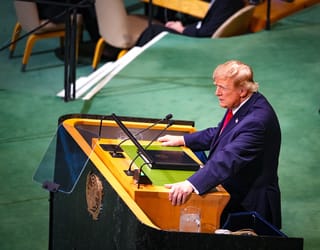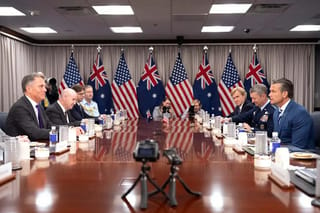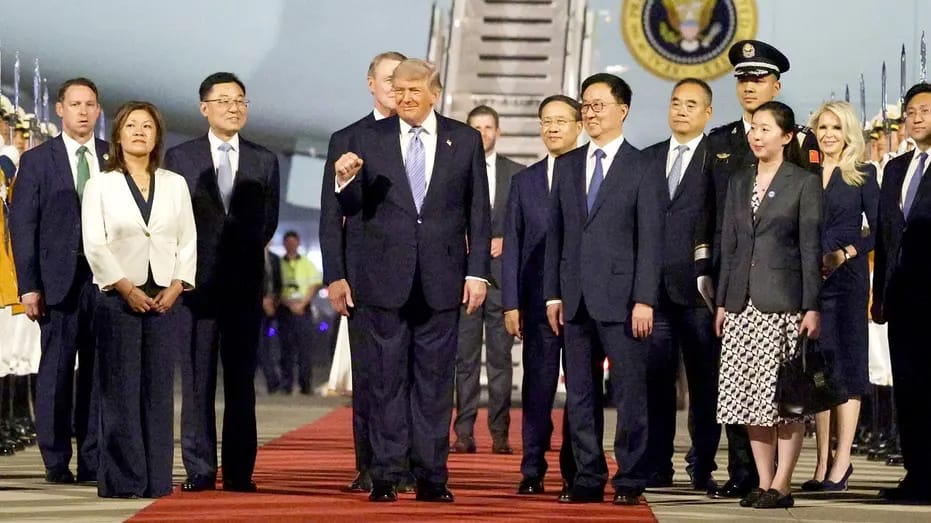
President Donald Trump touched down at Beijing Capital International Airport on May 14 aboard Air Force One for his first China visit since November 2017, facing discussions with Xi Jinping that will test American strategy in what increasingly resembles a new Cold War centered on artificial intelligence and technological supremacy.
The two-day summit, scheduled to conclude May 16 at the Great Hall of the People, carries unprecedented stakes. Trump arrives with a 47-member delegation including Treasury Secretary Janet Yellen, Commerce Secretary Gina Raimondo, and National Security Advisor Jake Sullivan. Chinese officials confirmed the meetings will address semiconductors, Taiwan, Iran, rare earth minerals, tariffs, computing infrastructure and military stability across the South China Sea.
No Trump-Xi meeting in recent memory carries this level of geopolitical risk, with the Middle East in open conflict and China gaining military advantages while America remains focused on the Iran war. The timing gives Beijing unusual negotiating leverage over an administration stretched across multiple crisis zones.
The New Cold War Framework
This summit transcends routine trade disputes over soybeans and steel. Xi Jinping declared in a March 2024 address to the National People's Congress that mastery of artificial intelligence represents "the front line and main battlefield of international competition" — a strategic framework now driving Beijing's economic, military and technological ambitions.
China has backed those words with $1.4 trillion in planned AI and semiconductor investments through 2030, according to state media reports. The funding targets quantum computing, advanced chip manufacturing, and military AI applications. Beijing's Ministry of Industry and Information Technology announced 127 new semiconductor facilities under construction across 15 provinces, designed to reduce dependence on Taiwan Semiconductor Manufacturing Company and other foreign suppliers.
The Iran conflict has forced closure of the Strait of Hormuz since April 28, triggering the most severe global energy shock since the 1973 oil embargo and giving Beijing unusual leverage over economies desperate for stable supply chains. Meanwhile, Taiwan faces mounting Chinese military pressure as Taiwan officials worry Trump might trade the island's security for economic concessions.
America's Strategic Challenge
For years, American policymakers viewed China primarily through an economic lens focused on trade deficits and market access. That era has ended. Beijing now openly links computing power, industrial policy, military modernization, surveillance systems and digital infrastructure into a unified strategy of national power.
The People's Liberation Army has integrated AI systems into 73% of its missile defense network, according to Pentagon intelligence assessments leaked to Congress in April. Chinese military researchers published 2,847 AI-related papers in 2023, compared to 1,213 from American institutions, Defense Department analysts reported to the Senate Armed Services Committee.
The discussions will determine whether Washington fully grasps the scale of the contest unfolding. Trump and Xi are not merely negotiating trade balances — they are negotiating who shapes the international order for the next generation. China controls 87% of global rare earth mineral processing, essential for advanced semiconductor production, giving Xi substantial leverage over any technology agreements.
High Stakes for American Strategy
The timing puts America at a disadvantage. While 85,000 U.S. forces remain deployed against Iran's military at highest readiness levels across the Persian Gulf, China has accelerated its own technological and military development programs. The Pentagon estimates Beijing increased defense spending by 12.3% this year, reaching $298 billion.
Trump faces pressure to secure concrete wins on multiple fronts: reducing America's technological dependence on Chinese supply chains, preventing Beijing's military expansion in the South China Sea, and maintaining Taiwan's security without triggering open conflict. Congressional Republicans have demanded Trump secure commitments on semiconductor supply chains, while Democrats push for human rights guarantees.
The outcome will signal whether America can compete effectively in this new era of great power competition while managing active military commitments elsewhere. Watch for announcements on semiconductor agreements expected May 15 and any shift in Taiwan arms sales policies. The next major decision point comes June 3 when Congress votes on the Taiwan Security Enhancement Act, potentially constraining Trump's negotiating flexibility with Beijing.