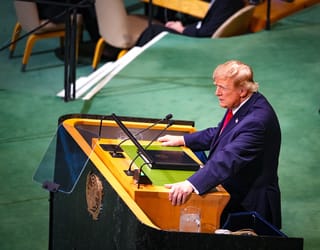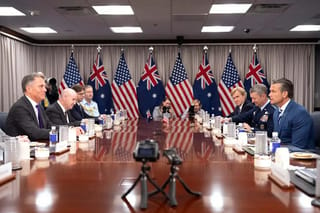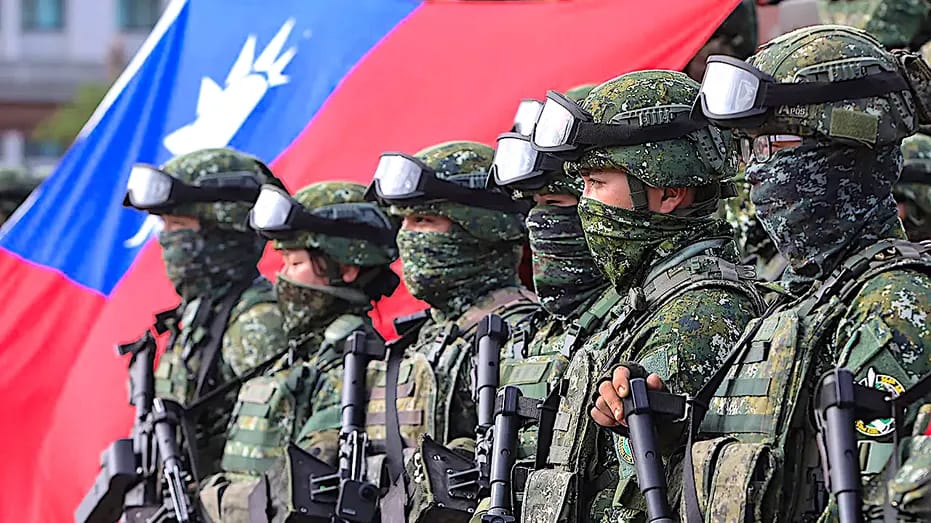
Taiwan's government is bracing for President Trump's upcoming meetings with Chinese leader Xi Jinping in Beijing, fearing the communist dictator will offer trade concessions in exchange for weakening American support for the democratic island of 23 million people.
Officials in Kaohsiung, Taiwan warn that Xi may dangle cooperation on tariffs, fentanyl crackdowns, U.S. business access, or global flashpoints like Iran and Ukraine to secure Trump's acceptance of greater Chinese control over Taiwan's future. The Chinese Communist Party claims Taiwan as its territory despite never having ruled it.
Taiwan Officials Sound Alarm
Francois Wu, Taiwan's Deputy Minister of Foreign Affairs, recently expressed the island's deepest concern to Bloomberg News during a press conference at the Ministry's Taipei headquarters.
What we are the most afraid is to put Taiwan on the menu of the talk between Xi Jinping and President Trump.
Wu's warning comes as Taiwan's diplomatic corps works overtime to prevent their nation from becoming a bargaining chip. The Foreign Ministry has dispatched senior officials to meet with Republican congressional leaders and Trump transition team members, seeking assurances that Taiwan's security won't be compromised for economic gains.
Huang Kwei-bo, a professor at National Chengchi University's Department of Diplomacy, told Fox News that Taiwan shouldn't assume nothing will change behind closed doors. He warned the U.S. and mainland China could reach a secret understanding to reduce arms sales to Taiwan or become less active in helping the island participate in international organizations.
Trump acknowledged Monday that China's opposition to U.S. arms sales to Taiwan would be "one of the many things I'll be talking about" during his Beijing visit, as Insider Wire previously reported. Current U.S. arms commitments to Taiwan total $15.7 billion in pending sales, including 66 F-16V fighter jets and 108 M1A2T Abrams tanks.
Historical Pattern of Pressure
Taiwan's concerns reflect decades of diplomatic vulnerability. During the 1970s, President Nixon surprised Taiwan by opening relations with Beijing without advance warning to Taipei. In 1982, President Reagan agreed to gradually reduce arms sales to Taiwan as part of a joint communique with China, though subsequent administrations have ignored those limits.
The island's semiconductor industry adds economic complexity to any potential deal. Taiwan Semiconductor Manufacturing Company produces 92% of the world's most advanced chips, making the island indispensable to American technology companies and defense contractors. Any Chinese move against Taiwan would cripple supply chains worth $574 billion annually to the U.S. economy.
China Maintains Military Pressure
Beijing has escalated pressure on Taiwan in recent weeks. Over the past seven days, more than 50 communist Chinese aircraft crossed the Taiwan Strait median line or entered Taiwan's air defense identification zone. While not a dramatic escalation, these flights represent what Taiwan now sees as a "new normal" — sustained pressure that keeps the island's military on constant alert without triggering full-scale war.
China also intentionally damages Taiwan's undersea cables and conducts regular live-fire military drills near the island. The People's Liberation Army recently launched rockets and surrounded Taiwan with warships and aircraft during exercises designed to demonstrate Beijing's ability to blockade the island. These drills involved 125 aircraft and 34 naval vessels, according to Taiwan's Defense Ministry.
Chinese coast guard vessels have increased patrols around Taiwan's outer islands, with 47 documented intrusions into restricted waters during December alone. Beijing's strategy appears designed to normalize its military presence around Taiwan while avoiding actions that would force an immediate U.S. response.
What to Watch Next
Taiwan's fate may hinge on Trump's first 100 days in office. The new administration faces an immediate decision on whether to approve $2.2 billion in additional arms sales Taiwan requested in November, including advanced missile defense systems and radar equipment.
Congressional Republicans plan hearings on U.S.-Taiwan relations in February, providing a platform for Taiwan's supporters to pressure Trump against any concessions to Beijing. Senate Foreign Relations Committee Chairman Marco Rubio has already signaled strong opposition to any reduction in Taiwan support.
Taiwan's leaders will be watching closely to see whether Trump negotiates from strength or leaves America's democratic ally exposed to communist aggression in pursuit of trade deals. The stakes extend far beyond Taiwan's shores, potentially reshaping the balance of power across the Pacific for decades to come.