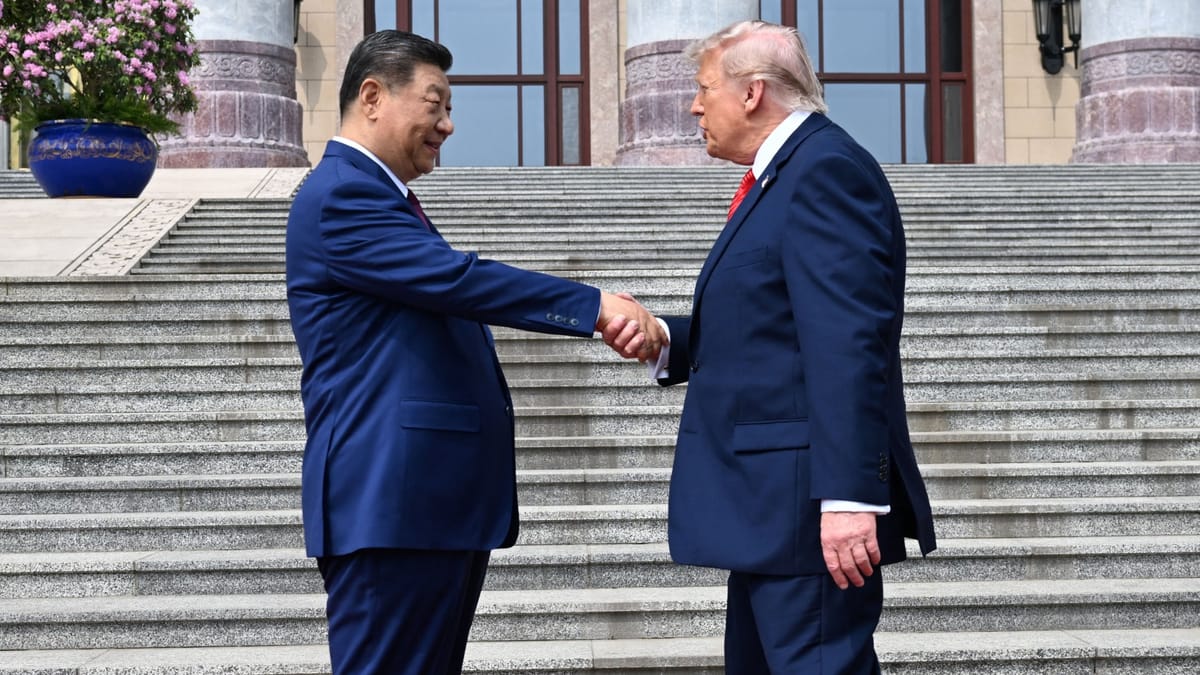
President Donald Trump met with Chinese leader Xi Jinping at the Great Hall of the People in Beijing Thursday morning at 9:30 AM local time, launching what White House officials described as a 4-hour negotiating session covering America's most pressing security and economic disputes with the world's second-largest economy.
The two leaders exchanged handshakes in the ornate East Hall before moving to private talks involving Secretary of State Marco Rubio, Treasury Secretary Scott Bessent, and Chinese Foreign Minister Wang Yi. The agenda centers on $400 billion in annual trade imbalances, Iran's uranium enrichment program, and Taiwan's $18 billion arms procurement pipeline — issues that directly impact American manufacturing jobs, military positioning, and regional stability.
Trump's 72-hour Beijing visit comes as economic concerns mount over his Iran policy and amid fears that Taiwan's security could be traded for Chinese trade concessions.
Trade Tensions Take Center Stage
American negotiators arrived with demands to reduce China's $382 billion trade surplus with the U.S., eliminate subsidies to state-owned steel and aluminum producers, and open Chinese markets to American agricultural exports worth an estimated $50 billion annually. Trump imposed 25% tariffs on $250 billion in Chinese goods during his previous term, measures that remain in effect and cost American consumers roughly $80 billion in higher prices since 2018.
Chinese officials counter-proposed increasing purchases of American soybeans, natural gas, and Boeing aircraft by $200 billion over three years, while seeking removal of export controls on semiconductor technology that have cost Chinese manufacturers access to advanced chips. The technology restrictions, implemented in October 2022, affect companies like Semiconductor Manufacturing International Corp and limit China's artificial intelligence development.
Banking regulations also feature in discussions, with China seeking access to American capital markets for its largest state banks, currently restricted under Treasury Department rules implemented in 2020.
Iran Nuclear Program Complicates Negotiations
Iran's role adds complexity to the Beijing talks, as China imports 1.2 million barrels of Iranian oil daily despite U.S. sanctions, providing Tehran with roughly $40 billion in annual revenue. Trump administration officials want Beijing to reduce these purchases by 75% within six months, threatening secondary sanctions on Chinese banks that process Iranian transactions.
Iran has enriched uranium to 60% purity at its Fordow facility, approaching the 90% threshold needed for weapons production. Chinese cooperation in isolating Iran's nuclear program could determine whether diplomatic solutions remain viable or military options become necessary. Beijing's influence stems from its position as Iran's largest trading partner, accounting for 35% of Tehran's total commerce.
Trump's approach to the summit comes after reports that he might consider concessions on Taiwan arms sales to secure broader economic agreements with China.
Historical Context and Strategic Stakes
This marks the first U.S.-China summit since Joe Biden met Xi in San Francisco in November 2023, where the leaders agreed to resume military communications but failed to resolve core disputes. Trade tensions have escalated since Trump's initial presidency, when bilateral commerce peaked at $690 billion in 2017 before tariffs and sanctions reduced exchanges to $550 billion by 2023.
Taiwan represents the most sensitive issue, with China claiming sovereignty over the democratic island of 23 million people. The U.S. maintains unofficial relations through the Taiwan Relations Act, selling defensive weapons and maintaining strategic ambiguity about military intervention. Any American retreat from Taiwan support would reshape Pacific power dynamics and potentially encourage Chinese territorial expansion.
What's Next
Negotiations continue Friday with expanded delegations including U.S. Trade Representative officials and Chinese Commerce Ministry representatives. Trump plans a joint press conference Saturday at 2 PM Beijing time, where concrete agreements on trade volumes, technology transfers, and Iranian sanctions could be announced. Congressional leaders including House Speaker Mike Johnson expect detailed briefings upon Trump's return to Washington Sunday evening, with any major Taiwan concessions requiring Senate Foreign Relations Committee review within 30 days.