For nearly half a century, Washington has continued to misunderstand the Iranian question. American policymakers still analyze Iran through the exhausted framework of diplomacy, sanctions, nuclear negotiations, regional containment, and temporary crisis management.
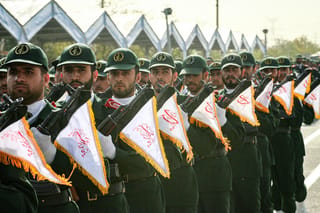
Yet beneath all the briefings, intelligence reports, negotiations, and diplomatic theater lies a reality that should no longer be ignored: the Islamic Republic is not Iran, and preserving the Islamic Republic is not the same as preserving stability. The regime survives not through genuine legitimacy, ideological loyalty, or a credible vision for Iran’s future, but through terror, repression, propaganda, and an enormous military-security apparatus. If Washington is ever to take regime change seriously, this is the moment. The opportunity should not again be squandered through hesitation, containment, strategic ambiguity, or another futile agreement with a regime whose political identity is inseparable from hostility toward America, Israel, and the free world.
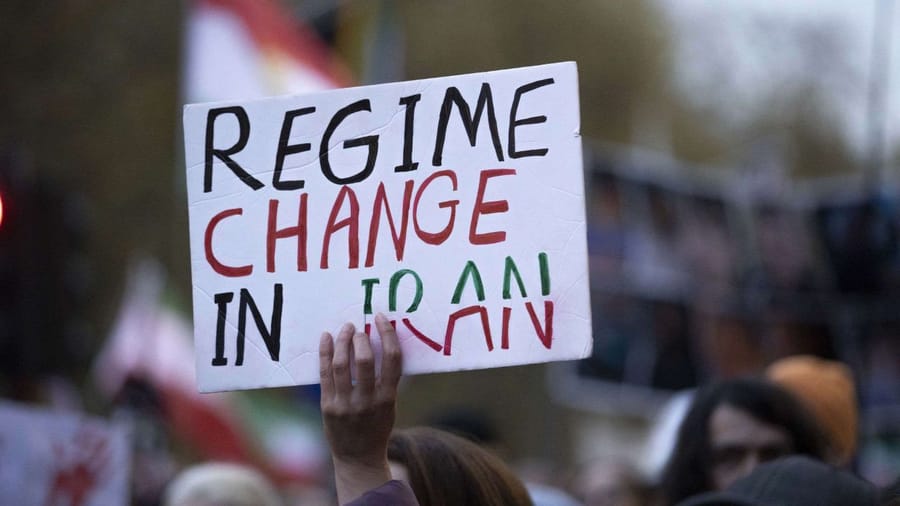
Unfortunately, there is still no serious political will in Washington for regime change. The United States has repeatedly treated the symptoms of the Iranian crisis while refusing to address its source. Financial pressure, sanctions, isolation, military deterrence, and negotiations will lead nowhere if they are not ultimately directed toward a clear political objective. The Islamic Republic is not a conventional government pursuing conventional national interests. It emerged in 1979 as an ideological revolutionary system, and confrontation with America and Israel became part of its political identity. Its so-called reformists and hardliners may quarrel over tactics, but they remain within the same structure of clerical rule. Washington cannot continue searching inside the same establishment for another supposedly reasonable faction and call that transformation. The Iranian people are not demanding the rearrangement of factions within the Islamic Republic; they are demanding a transition away from clerical rule itself.
For years, circles inside the United States sympathetic to engagement with Tehran have promoted the illusion that the so-called reformists represent an alternative to the Islamic Republic’s fundamental character. The regime itself has benefited enormously from this narrative. The reformist vocabulary gives Washington an excuse to distinguish between different faces of the same political establishment while ignoring the machinery underneath. Lobbying and influence networks associated with promoting accommodation with Tehran have repeatedly amplified the reformist narrative in America. Believing indefinitely that the Islamic Republic can be transformed by recycling another faction from within its own ruling establishment is not sophistication. After forty-seven years of evidence, it is political foolishness. The regime changes presidents, diplomats, slogans, and negotiating styles; the system survives, the IRGC survives, the intelligence machinery survives, and the ideological commitment to preserving the Islamic Republic survives.
The same intellectual confusion is visible in Washington’s obsession with 1953. History deserves serious scrutiny, not mythmaking unsupported by evidence or reasoned argument. Mossadegh was a populist, dishonest, ineffectual, controversial, and authoritarian prime minister—not a sacred, romanticized figure somehow immune from historical examination. He was not directly elected by the Iranian people in a national election to serve as prime minister. He also dissolved a parliament that had become critical of him, suppressed hostile newspapers, governed for much of his premiership under martial law, and presided over the repression and mistreatment of political opponents. The almost mythological glorification of Mossadegh is therefore not serious historiography; at times, it borders on the absurd.
The mythology surrounding 1953 has helped obscure the far greater strategic catastrophe of 1979. Washington failed to understand Khomeini, underestimated the ideological character of his movement, misunderstood the historical relationship between Iranian society and monarchy, and watched one of America's most important regional allies disappear. SAVAK, one of the CIA and Mossad's closest intelligence partners during the Cold War, had warned about the relationship between radical Islamist and Marxist movements and Soviet activities, yet Washington repeatedly underestimated the revolutionary danger. The CIA should eventually release whatever remaining historical records can lawfully be declassified concerning American contacts with Khomeini's entourage, including contacts involving figures around Mohammad Beheshti and Ebrahim Yazdi. Only then can the historical record be examined without mythology. The central lesson of 1979 should be brutally simple: intelligence failure does not always result from a lack of information; sometimes it results from refusing to understand the information already available.
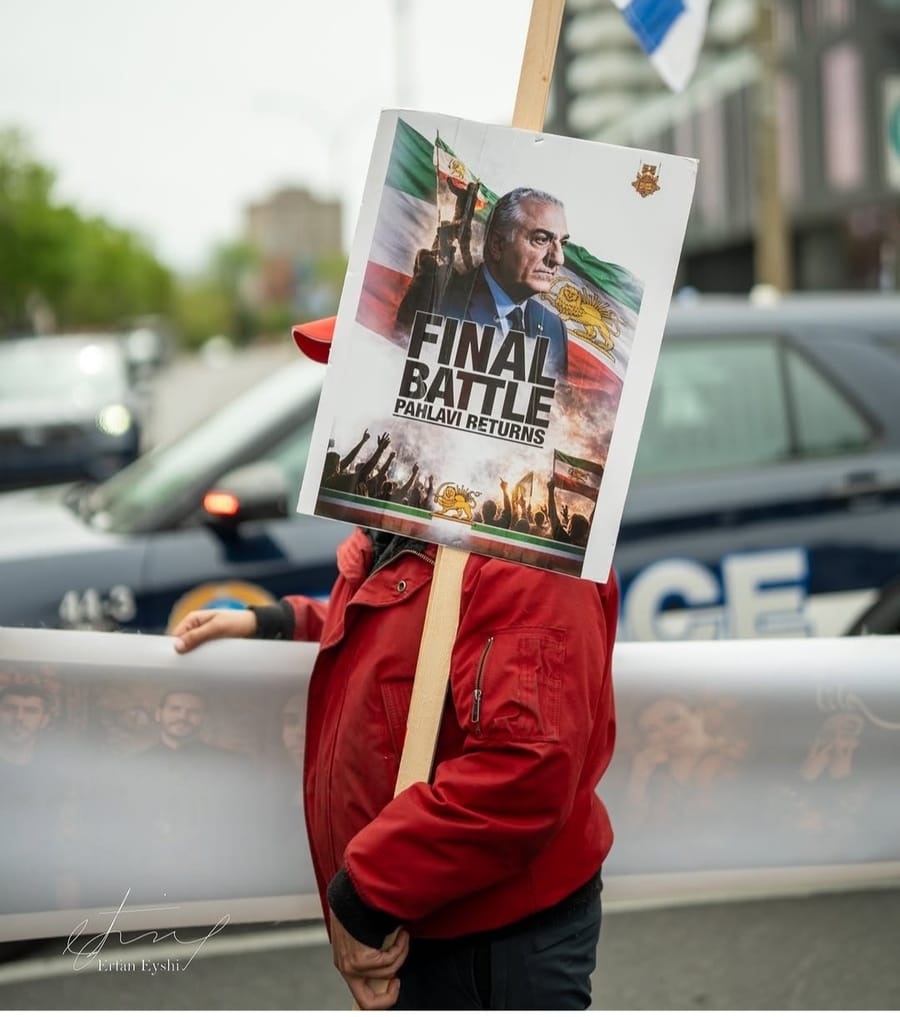
Washington is in danger of repeating another version of that mistake by refusing to recognize the political center of gravity of the Iranian opposition. Among the manufactured, discredited, self-appointed, separatist, Marxist, Islamist, and foreign-based organizations presented over the years as alternatives, only one political personality possesses the national name, historical continuity, and capacity to unite significant numbers of Iranians beneath a national banner: HRH Crown Prince Reza Pahlavi. Iran does not need another artificial opposition manufactured abroad. It does not need the MEK thugs, Marxist-Leninist factions, terrorist separatist organizations (PDKI, Komala, PAK, Khabat or Barzani), smugglers, armed corrupted ethnic groups, or political actors compromised by relationships with the IRGC terrorists. A transition requires a national center of gravity, and The HRH Reza Pahlavi remains uniquely positioned to provide it.
The CIA and Mossad certainly know that, while paying attention to and respecting Iran’s territorial integrity, their job is not nation-building. Their task is to pay attention to rebuilding SAVAK so that, after the collapse of the mullahs’ regime, security can be maintained in the country. Crown Prince Reza Pahlavi’s “Iran Prosperity Project” has been introduced and discussed among Iranians, but have Mossad and the CIA paid attention to the training and preparation of a security institution? It can be said with confidence that, up to this point, this important issue has been neglected, and it cannot be allowed to remain neglected.
This reality has become increasingly visible inside Iranian society itself. After decades of anti-Pahlavi propaganda, young Iranians born long after 1979 continue to compare the country they inherited from the Islamic Republic with the Iran that existed before the revolution. The Pahlavi name has survived forty-seven years of systematic demonization because it remains associated for many Iranians with national identity, modernization, secular government, territorial integrity, and an Iran connected to the modern world. Islamist groups, Marxists, separatists, and remnants of the revolutionary coalition of 1979 cannot manufacture comparable national legitimacy simply through conferences, foreign funding, television exposure, or political lobbying
Regime change, however, must never mean the destruction of the Iranian state. Iran is an ancient and cohesive nation with a powerful historical identity and a deeply rooted tradition of statehood. Washington does not need another nation-building adventure. It needs to understand the difference between dismantling an ideological dictatorship and dismantling a country. Iran's territorial integrity must be protected, and Kurds, Baluch, Azeris, Arabs, Persians, and every other Iranian citizen must possess equal rights within a unified Iran. Empowering armed separatist organizations would replace one national-security disaster with another. The objective must be the collapse of the regime, not the disintegration of the Iranian state.
The greatest practical challenge will therefore be security during the transition. The collapse of the clerical establishment could leave behind armed IRGC factions, intelligence networks, underground Islamist cells, organized criminal structures, and terrorist forces loyal to the former regime. Tehran's regional architecture has for decades depended upon Islamist terrorist forces and proxy organizations connected to the regime. Their disappearance will not automatically follow the disappearance of the political leadership in Tehran. Iran will therefore need a powerful, professional, secular national intelligence organization capable of protecting the state during the transition and dismantling the remaining terrorist networks of the Islamic Republic.
The institutional experience of SAVAK should not simply be thrown into history's garbage bin. Before 1979, the CIA and Mossad maintained significant intelligence cooperation with Iran and were important partners of SAVAK. A new, well-trained Iranian national intelligence service, supported by cooperation with the CIA, Mossad, and American counterterrorism expertise, including the National Counterterrorism Center, could gradually assume responsibility for protecting Iran during the transitional period, confronting surviving Islamist terrorist networks, securing sensitive installations, and preventing the country from descending into civil war or militia rule. There is no need for an installed elite or puppet regime. The objective should be a successful transition until Iranians can determine their political future without becoming trapped in a prolonged multisided civil war, chaos, proxy warfare, or the violence of underground Islamist organizations carrying the same ideological ethos as the former regime.
Washington's hesitation has already carried a terrible human cost. Had the United States not obstructed Israel from finishing the job when the opportunity existed, the regime could have fallen earlier, and the subsequent slaughter of Iranians in January 2026 might never have occurred. Instead, Iranian society again paid in blood while Washington returned to its familiar vocabulary of negotiation, restraint, de-escalation, and agreement. The Iranian people did not repeatedly enter the streets, endure imprisonment and torture, and sacrifice their lives merely so that Washington could eventually replace one face of the Islamic Republic with another.
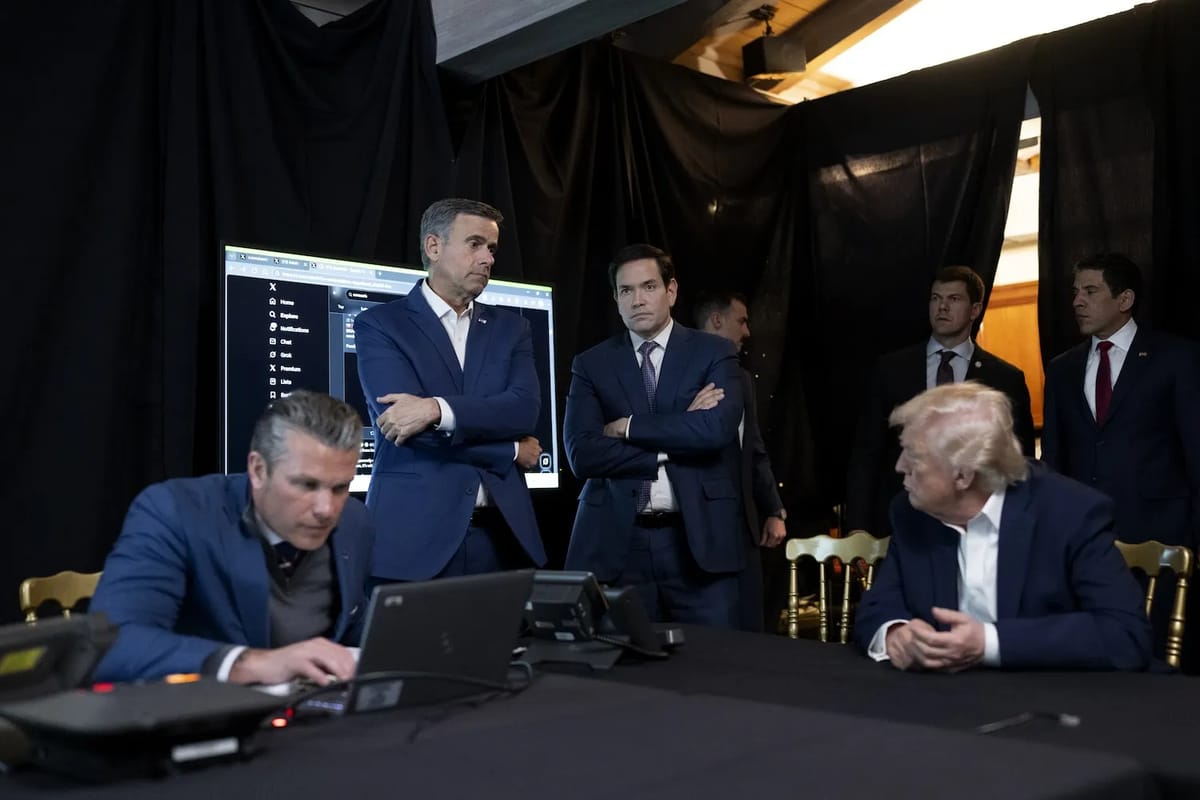
Washington cannot simultaneously tell Iranians that their aspiration for freedom is legitimate, declare that “help is on the way,” and then construct a strategy whose practical purpose is to prevent the political system suppressing those aspirations from collapsing. It cannot encourage people to challenge a dictatorship and then effectively tell them to go home because another agreement, another negotiation, and another commemorative photograph with representatives of the same regime have suddenly become more important. Nor can Washington repeatedly search inside the same brutal establishment for a supposedly “reasonable” faction and describe this as political transformation while showing virtually no respect for what Iranians themselves have repeatedly demanded.
America went to war against Islamic terrorism and the Islamic dictatorship of the Shiite mullahs in Tehran apparently to obtain a better deal rather than to achieve a final political outcome. But a better agreement with the Islamic Republic and the end of the Islamic Republic are not the same policy. One prolongs the management of a forty-seven-year crisis; the other addresses its political source. For nearly half a century, Washington has feared what the Islamic Republic might do if confronted decisively. Perhaps the question Washington should finally ask is more uncomfortable: Why is America so frightened of what Iran could become once the Islamic Republic is gone?
The Iranian nation has moved beyond the sinister institution of the Shiite clergy, and those who have stood alongside the current brutal, repressive, destructive, and occupying regime have no value or credibility in Iran. Just as the Nazis were banned after the liberation of Germany, certainly after the collapse of the regime, that sinister and fear-inducing clerical attire and its propaganda organization will also be banned. Have you ever seen, in the twenty nationwide anti-government movements of the past forty-eight years, even one mullah killed in the struggle for Iran’s freedom and democracy? No. A good mullah is a dead mullah. The Fall of Tehran Is Near.