If reports that the CIA has given Israel a “do not kill” list of senior Iranian officials deemed capable of playing roles in a future government are accurate, Washington may already be contemplating a question it failed to anticipate nearly half a century ago: who governs Iran the day after the regime falls?
These days, much as nearly half a century ago, the contours of regime collapse in Iran remain difficult to discern. Forty-eight years ago, around this time, then-CIA Director Stansfield Turner met with senior SAVAK official Parviz Sabeti — a respected Iranian patriot trusted by the late Shah. The bitter irony is that no one at Langley believed that by January 26, 1979, Iran would be plunging into an abyss of collapse and destruction; that a civilization with 7,700 years of history would be seized and occupied by a mafia of Shiite mullahs; or that Islamic terrorism would acquire the power and wealth of a state.
The intelligence problem today is different but historically familiar: Washington may again misread the indicators of impending political rupture. This time, however, regime weakness creates an additional security problem. A regime approaching collapse may attempt to compensate for its internal vulnerability through external military escalation, making the prospect of a third war inseparable from the question of regime survival.
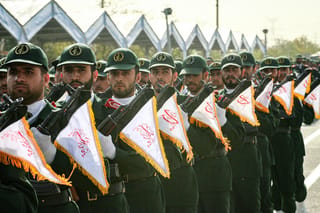
Following the humiliating death of Tehran’s dictator, Ali Khamenei, the ruling establishment has been destabilized, and Iran is increasingly governed by what amounts to a military junta. The regime has also lost control of the economy, while internally it confronts an angry and impoverished population and the persistent threat of a nationwide uprising. These domestic vulnerabilities are developing simultaneously with a deterioration of Iran’s regional strategic position.
For decades, the Islamic Republic constructed strategic depth through proxy and irregular warfare, using Hezbollah, Hamas, the Houthis and other armed networks to impose costs on adversaries, extend deterrence beyond Iran’s borders and keep major conflict away from Iranian territory. That architecture is now under severe pressure. Hezbollah is collapsing; Hamas has lost its value as a strategic asset and has been effectively neutralized; and the Houthis are entering their final, increasingly desperate stage of decline. These successive setbacks have disrupted the Quds Force’s plans and reduced Tehran’s strategic room for maneuver. As its external buffers weaken, the regime itself becomes increasingly exposed, creating a direct relationship between the erosion of strategic depth abroad and insecurity at the center of power in Tehran.
Israel appears determined to dismantle what can be understood as the Islamic Republic’s three-layered ring of fire: terrorism and irregular warfare, missiles and drones, and the nuclear-weapons threat. U.S.-Israeli cooperation during the 12-day and 40-day wars changed this strategic equation by weakening components of the regional architecture on which Tehran had long depended. From the perspective of deterrence, the deterioration of the first layer may increase the importance Tehran assigns to the remaining two.
This is where regime survival and military strategy begin to intersect. Tehran openly warns through its media that the country is moving toward war; military and security officials issue apocalyptic threats against Trump while signaling an interest in strategic surprise and a preemptive strike; and even national newspapers shamelessly discuss the possible use of chemical, biological and nuclear weapons. The critical security question is therefore whether the erosion of Iran’s conventional and proxy leverage will restrain Tehran or instead encourage the leadership to rely more heavily on missiles, drones, strategic surprise and the nuclear-bomb claim as instruments of coercion.
From a security and intelligence perspective, the greatest danger may be strategic miscalculation under regime-survival pressure. A regime that believes the strategic balance will be worse tomorrow than it is today may conclude that the costs of waiting exceed the risks of acting first. Tehran increasingly sees itself backed into a corner and is contemplating a preemptive strike. If it chooses that path, it would constitute a grave miscalculation and an act of extraordinary recklessness, but conventional rationality should not necessarily be expected from a regime confronting what it perceives as an existential threat. This calculation is complicated by an apparent contradiction in Tehran’s behavior. With the support of America’s military and intelligence community and close coordination with Israel, Trump has recognized that the regime is desperately begging for a deal to escape its predicament. Yet Tehran continues to bully its adversaries because anti-Americanism and anti-Israelism remain fundamental pillars of Khomeinist ideology. The American and Israeli military and intelligence communities have also concluded that the regime has nothing left in its arsenal beyond the terrorism card and the nuclear-bomb claim. A leadership seeking negotiations while simultaneously preparing for escalation should therefore not automatically be interpreted as pursuing contradictory policies; both behaviors can be understood as instruments of the same regime-survival strategy.
For Washington, the operational problem is consequently larger than choosing between diplomacy and another military strike. The challenge is determining how additional pressure will interact with a political system already experiencing internal fragmentation and declining regional leverage. Military pressure could compel the regime, provoke escalation, accelerate domestic instability, or produce all three effects simultaneously. The Revolutionary Guards have threatened to widen the battlefield to countries allied with the United States throughout the region, demonstrating that a future confrontation need not remain geographically confined to Iran and Israel. Trump has already spent considerable time pursuing diplomacy without results because this is a regime with nothing to offer in international relations. Meanwhile, inside Iran, executions, arrests and violence are being used to subdue an angry population as economic isolation, encirclement and maximum pressure intensify. What remains largely intact is the machinery of repression and propaganda, together with those dependent upon preserving the existing order and the regime’s affiliated lobbying networks abroad. For American planners, therefore, military escalation cannot be assessed independently of internal political stability: action against the regime may generate second- and third-order consequences inside Iran that are as strategically important as the immediate military effects of a strike.
This interaction makes the third-war scenario particularly difficult to model. Another conflict could remain limited or expand rapidly across the region; another bombing campaign could further weaken the regime or ultimately force its surrender; Israel could conduct its next operation jointly with the United States or independently; and the regime’s remaining leadership could itself become part of the target set. Yet the most consequential scenario is a convergence of external war and internal revolt.
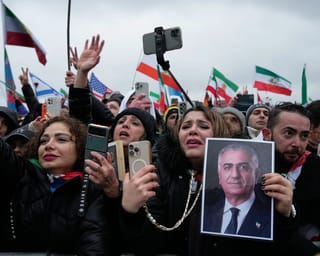
A third war could coincide with a nationwide uprising by the Iranian people, producing mutually reinforcing pressures: military degradation from outside and political fragmentation from within. Such a convergence could become the deep surgery that finally brings down the Islamic Republic, an outcome desired by the Iranian people and Israel and quietly wished for behind closed doors in the Persian Gulf states. Conversely, external attack could also provide the regime with an opportunity to intensify repression, invoke national emergency and attempt to redirect domestic anger toward foreign adversaries. The central analytical problem is therefore not merely whether war or uprising occurs first, but how the two dynamics could interact once a crisis begins.
Three years after October 7, Tehran thus confronts a strategic paradox. Its regional network is weaker, its economy is deteriorating, its domestic control is eroding and its freedom of military action is narrowing, yet those same weaknesses may increase rather than decrease its appetite for escalation. In deterrence terms, a regime with fewer options can become more dangerous if its leadership believes that delay will further reduce those options.
The intelligence challenge for Washington and Jerusalem is therefore not simply to predict Iran’s next military move, but to determine whether military escalation and internal regime collapse are becoming components of the same contingency. Nearly half a century after Langley failed to anticipate the speed of political collapse in Iran, the CIA and Mossad must now assess military indicators, regime-survival behavior and domestic instability as parts of a single strategic picture. The question at the center of that assessment is no longer merely whether there will be another confrontation with Tehran, but whether Iran’s third war could also become the Islamic Republic’s last.