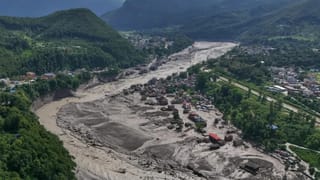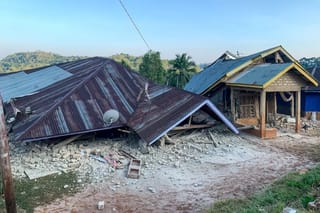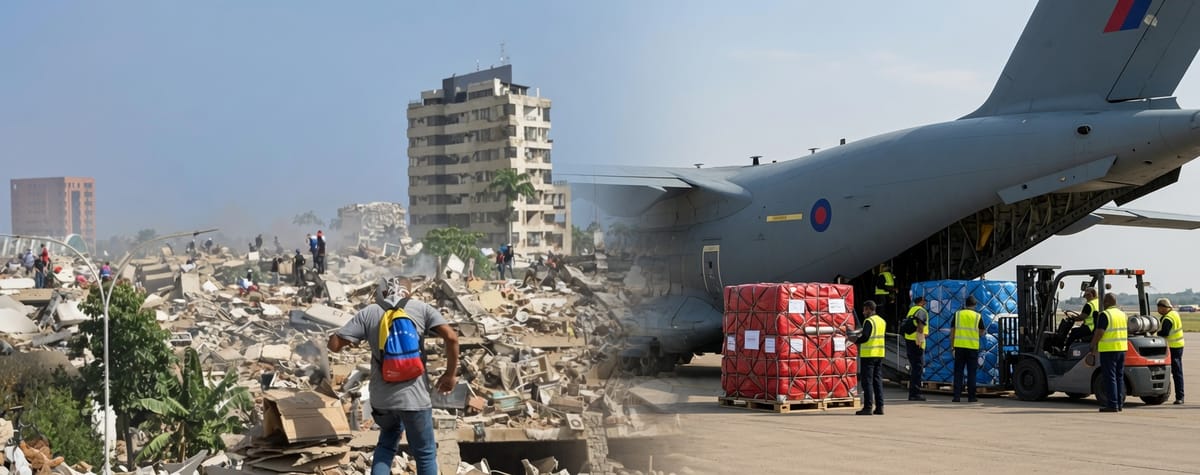
Two powerful earthquakes struck northern Venezuela in rapid succession on Tuesday, June 24, devastating the capital Caracas and the coastal La Guaira state in what seismologists are calling a rare seismic "doublet" event.
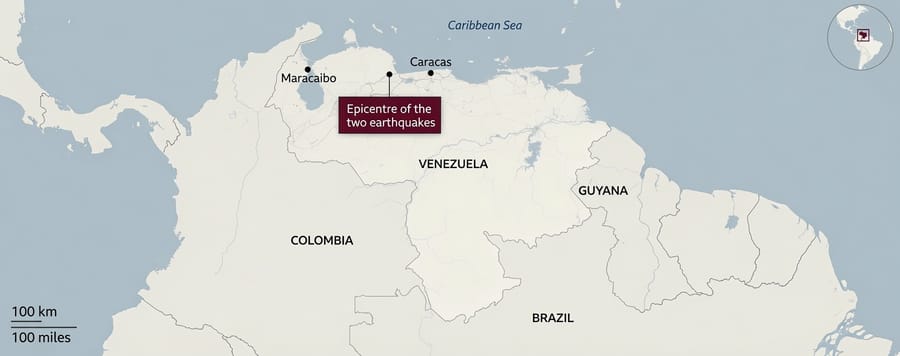
The United States Geological Survey recorded the first earthquake, the foreshock, as a magnitude 7.2; the main quake, which struck only 39 seconds later, was a magnitude 7.5, the strongest in Venezuela since 1900. The epicenter was located near Yumare/Morón in Yaracuy state, about 100 miles west of Caracas.
Severe widespread destruction occurred in La Guaira, with hundreds of buildings collapsed; Simón Bolívar International Airport was heavily damaged. Dozens of buildings also collapsed in Caracas, including high-rises in Altamira and Chacao. Shaking was felt across much of northern Venezuela and neighboring countries.
Venezuela’s acting president Delcy Rodríguez declared a state of emergency after visiting the area, calling La Guaira a disaster zone. The government also lifted social media restrictions to help with search efforts.
The death toll, which is expected to rise, has exceeded 900 and more than 49,000 people are unaccounted for. The international community has united in response with several countries sending vital assistance, including the U.S., Mexico, India, El Salvador, and Germany, as the window to save those still trapped under the rubble diminishes.
The recovery from a disaster of this scale is expected to take years. Critical infrastructure, including power, gas, and communications networks, remains severely disrupted across large areas. With casualties continuing to rise and thousands of people directly affected, search-and-rescue operations and humanitarian relief remain the immediate priorities. At the same time, authorities are already shifting focus toward long-term recovery as the country confronts the full scale of the unfolding tragedy.