Secretary of State Marco Rubio rejected Iran's latest peace proposal Monday, telling Fox News that Tehran's offer to ease control over the Strait of Hormuz falls short of U.S. demands as the conflict enters its third month.
Iran's proposal would loosen Tehran's grip on the strategic waterway in exchange for lifting the U.S. naval blockade, according to two officials familiar with the matter. But discussions on Iran's nuclear program would be delayed to an unspecified future date under the Iranian plan.
"The nuclear question is the reason why we're in this in the first place," Rubio said in the Fox News interview. The Secretary of State made clear that Washington will not allow Iran to retain control over the Strait of Hormuz or continue charging tolls to ships passing through the international waterway.
"Those are international waterways. They cannot normalize, nor can we tolerate them trying to normalize, a system in which the Iranians decide who gets to use an international waterway and how much you have to pay them to use it," Rubio stated.
Treasury Secretary Scott Bessent posted on X Monday that Iran's oil industry is "creaking" under pressure from the U.S. blockade. "While the surviving IRGC Leaders are trapped like drowning rats in a sewage pipe, Iran's creaking oil industry is starting to shut in production thanks to the U.S. BLOCKADE," Bessent wrote. He predicted Iran's pumping capacity "will soon collapse" and warned of imminent gasoline shortages inside Iran.
The peace talks come after President Trump announced "major combat operations" against Iran on February 28, launching massive joint U.S.-Israeli strikes targeting military, government and infrastructure sites. Initial U.S.-Iran negotiations in Pakistan earlier this month failed to produce an agreement, though Trump later announced an open-ended ceasefire extension.
Rubio highlighted concerns about Iran's internal political situation, noting that U.S. negotiators face complications beyond just Iranian officials. "One of the impediments here is that our negotiators aren't just negotiating with Iranians. Those Iranians then have to negotiate with other Iranians," he said, referencing questions about new Supreme Leader Mojtaba Khamenei's authority.
The standoff has major implications for global energy markets, as the Strait of Hormuz serves as a chokepoint for roughly 20% of the world's oil shipments. Iran's attempt to control the waterway threatens the free flow of commerce that American allies and trading partners depend on for economic stability.
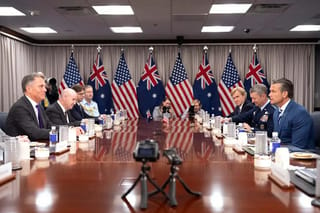
As Trump huddles with his security team on Iran's proposal, the administration faces pressure to resolve the crisis without compromising on core national security interests. The next phase of negotiations will test whether Iran's weakened position forces genuine concessions on its nuclear program.