Unfortunately, America went to war against Islamic terrorism and the Islamic dictatorship of the Shiite mullahs in Tehran in order to make a better “deal,” not to win the war.
Financial pressure, sanctions, and isolation, like so many other measures, will lead nowhere if they are not ultimately directed toward a clear and final political objective, which is "regime change". Trump complains that the Iranian people are not coming into the streets. But the question is: Why should they? When Iranians see that, even at the height of a declared determination to pursue regime change, Trump was still looking for a deal—and that even after enduring repeated humiliation from the Islamic Republic’s propaganda apparatus, Washington continues to speak of negotiation and agreement—why should they once again put their lives on the line? Bargaining with Islamic terrorists leads nowhere.
The Iranian people do not want to be slaughtered again while even the world’s media remain silent about their genocide. In the anti-regime protests against the criminal Shiite mullahs, Iranians saw that thousands of their compatriots could be slaughtered, wounded, blinded, imprisoned, and tortured while the central structure of power remained intact.
The Shiite mullah entered Iran’s political arena in the 1940s with the assassination of the Iranian writer and critic Ahmad Kasravi, who opposed religious superstition and the fake Hidden Imam, employing the doctrine of al-nasr bil-ru'b—“victory through terror.” From the 1960s onward, the clerical establishment increasingly pursued power and wealth, ultimately coming to power with the assistance of Islamic terrorism, Marxist terrorist groups, and Soviet support. It has ruled Iran for 48 years.
Historically, too, after the death of Muhammad, the first Islamic caliphate invaded Iran by the sword and defeated the Persian Empire through a similar logic. Centuries later, ISIS employed the same politics of terror, intimidation, and violence as it swept into Iraq and Syria. For these movements, violence and savagery has never been merely an accident or deviation; it has been an instrument for acquiring power, preserving power, and imposing political will.
Iranian society today is, of course, divided. A large part of the younger generation is thoughtful, realistic, and determined to live in the modern world. Yet the historical presence of the mullah in Iranian politics and society has left parts of the country’s intellectual foundations trapped in superstition, fantasy, and irrelevant prejudices that have not contributed even the slightest benefit to Iranian society or humanity.
The mullahs’ sinister apparatus devastated the intellectual foundations of Iranian society. They constantly repeat, for example, that Hussein stood with 72 men against an army of ten thousand, transforming this narrative into a political culture of futile resistance and glorification of death. Today, the diplomats of the Islamic Republic, representing a ruined and collapsing country, still imagine themselves marching against America, the West, and Israel and destroying them all. They have even created the ridiculous circus of Arbaeen as a new market and storefront for Islamic propaganda in competition with the Hajj.
But this time, Iranian society is not merely demanding the replacement of a few officials or the rearrangement of factions within the Islamic Republic. It demands a transition away from clerical rule itself. “Pure Muhammadan Islam,” state-sponsored Shiism, the false Hidden Imam, the seminaries, and the entire apparatus that has cast its shadow over Iranian politics, culture, and private life for nearly half a century must be sent, together with the Islamic Republic, to the graveyard of history.
The end of the Islamic Republic must simultaneously mark the end of the organized propagation of superstition, delusion, fanaticism, and stupidity within Iranian society. This is not merely about changing a government. It is about liberating society from an ideological and political machinery that has reproduced backwardness, violence, and obedience for decades.
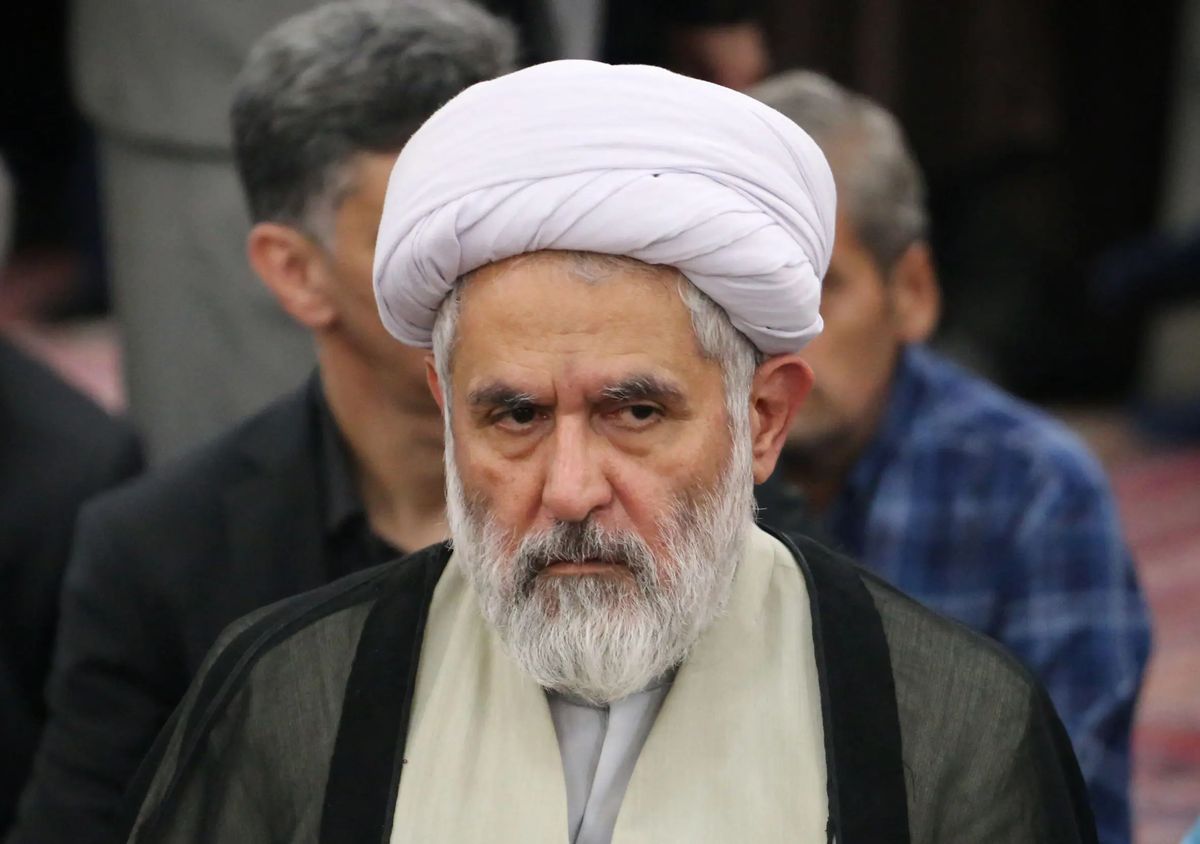
It is in this context that the security plan of Hossein Taeb—a bloodthirsty wolf alongside someone like Ejei—to eliminate opponents and challengers of the third caliph of the Islamic caliphate of Velayat-e Faqih, Mojtaba Khamenei, acquires its true meaning. In recent days, Hossein Taeb, the new commander of the Basij, has begun implementing a terrifying security plan aimed at eliminating Mojtaba Khamenei’s rivals within the ruling establishment and preventing the emergence of any internal protest. Behind all these measures lies one overriding fear: the regime’s terror of another nationwide uprising by the Iranian people.
The rulers in Tehran know that the Iranian people today carry an accumulated rage and hatred toward them because, in every uprising, this regime has killed, imprisoned, executed, and tortured thousands. It has blinded people and left others permanently disabled. The Islamic Republic understands better than any foreign government how much social fury could be unleashed on the day of its collapse. Even the graves of Khomeini and Khamenei may not be spared from that fury, and the mask of fabricated sanctity will no longer protect them. A regime that has governed through fear for decades is now itself terrified of a society that no longer believes in its manufactured holiness.
The regime has become acutely aware of this public mood and potential reaction, and no one understands better than the regime itself just how chaotic conditions inside Iran have become. The future looks increasingly hopeless for the ruling establishment, and many of its operatives may not even have anywhere in the world to which they can escape. In this atmosphere, a rabid dog and bloodthirsty wolf such as Taeb has entered the scene with the logic of killing and repression. Yet the continuation of this situation could place Iran on the edge of civil war and chaos. This assembly of madmen and servants of evil will not voluntarily relinquish power except under force. What confronts Iran today is a wretched, humiliated regime, suffering and moving toward decay. The twenty-first century has no need for such a cancerous tumor. It must be surgically removed and discarded. The question is whether Washington and the White House can hear this message.
Trump likes to speak of “regime change,” but what has been demonstrated so far has not revealed a genuine and coherent determination to achieve that objective. One cannot simultaneously call upon the Iranian people to rise up and, at the most critical moment—in the midst of their uprising—pursue a deal or an “agreement” with the very government they are risking their lives to overthrow.
Seeking a deal in the middle of a popular uprising is a dagger in the back of a nation’s aspirations—a nation that must be certain that if it returns to the streets, it will not once again be abandoned. That approach destroyed trust, and rebuilding that trust will be extraordinarily difficult. If Washington genuinely seeks regime change in Iran, it must first decide whether its objective is a better deal with the Islamic Republic or the end of the Islamic Republic. They are not the same policy.
Mr. President should hear the true voice of the Iranian people and the unmistakable demand rising from Iran: “Finish the job.” And in Iran, finishing the job means one thing: regime change. Period.