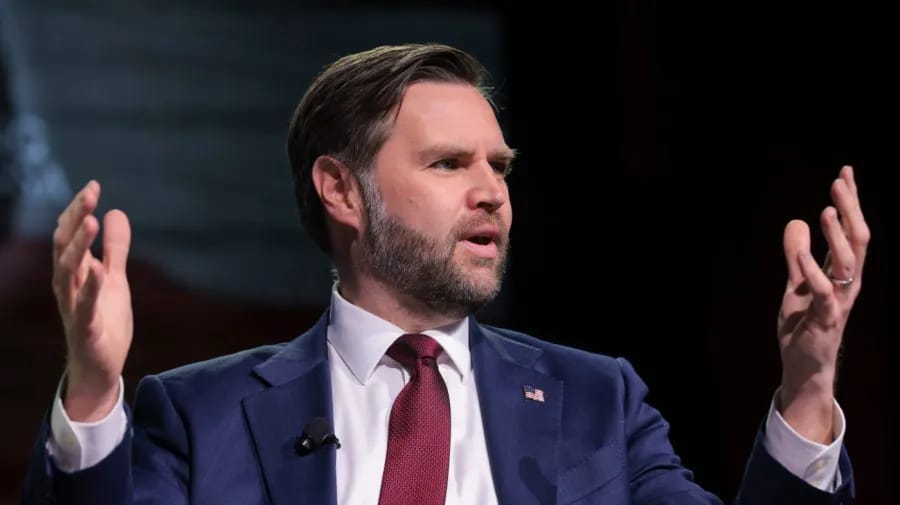
Vice President JD Vance deflected questions about his 2028 presidential ambitions and speculation about running alongside Secretary of State Marco Rubio during a White House press conference Wednesday afternoon. The exchange came during a 22-minute briefing focused on the administration's infrastructure priorities.
Vance dismissed the political chatter with characteristic bluntness when pressed by CNN's Kaitlan Collins about his future plans. He told reporters there are "few topics that I want to talk about less than what office I'm going to run for" in the next election cycle. The vice president fielded three separate questions about 2028 before cutting off the line of inquiry entirely.
Early 2028 Speculation Heats Up
The questions signal how quickly Washington's political class has shifted focus to the next presidential race, even as the Trump administration settles into its second term. Political betting markets already list Vance as the 3-to-1 favorite for the 2028 Republican nomination, according to data from PredictIt and Polymarket.
Vance, at 40 years old, represents the next generation of conservative leadership and would enter 2028 as a natural frontrunner for the Republican nomination. His youth advantage becomes more pronounced when compared to potential Democratic rivals like Gretchen Whitmer (53) and Josh Shapiro (51).
Rubio's name surfacing as a potential running mate reflects the Florida senator's rising profile as America's top diplomat. The 53-year-old Cuban-American politician brings foreign policy credentials and appeal to Hispanic voters that could strengthen any future ticket. Recent polling shows Rubio with 68% approval among Florida Republicans and 52% approval among Hispanic voters nationwide.
Historical Context for VP Speculation
Vance's deflection follows the playbook of sitting vice presidents who typically avoid discussing their political future until their current boss leaves office. Mike Pence similarly dodged 2024 questions throughout 2019 and 2020, while Joe Biden waited until April 2019 to announce his 2020 presidential campaign despite widespread speculation during the Obama years.
The early focus on 2028 reflects the Republican Party's unusual position of having a clear succession plan. Unlike 2016, when 17 candidates competed in a chaotic primary, or 2024, when Trump's dominance cleared the field, the party appears to be coalescing around Vance as the heir apparent.
This speculation intensified following Vance's well-received performance during the October 2024 vice presidential debate and his role in securing wins in Pennsylvania, Michigan, and Wisconsin during the general election campaign.
Constitutional Dynamics at Play
The Vance-Rubio speculation also raises interesting constitutional questions. Both men hail from states crucial to Republican electoral math — Ohio for Vance and Florida for Rubio. However, the 12th Amendment doesn't prohibit running mates from the same region, despite common political wisdom suggesting geographic balance.
Florida's 30 electoral votes and Ohio's 17 electoral votes combined represent 8.7% of the total Electoral College. A Vance-Rubio ticket would need to demonstrate appeal beyond their home states, particularly in swing states like Arizona, Nevada, and North Carolina.
The constitutional question becomes moot if either politician changes residency before 2028, as Dick Cheney did when he switched from Texas to Wyoming in 2000 to avoid complications with George W. Bush's Texas residency.
What's Next
For now, Vance's focus remains on his current role, as Insider Wire previously reported regarding his succession preparations. His refusal to engage in 2028 talk Wednesday suggests he's taking the long view on his political future.
The next major test for Vance comes during the midterm elections in 2026, where his campaigning for Republican candidates will provide the first real measure of his political appeal beyond Trump's shadow. The vice president has already committed to 12 fundraising events across eight states before Labor Day.
The vice president's evasion won't stop the speculation. If anything, it confirms what Republicans already know — Vance sits at the center of the party's future, whether he wants to discuss it or not. Political observers expect more formal 2028 positioning to emerge after the 2026 midterms, following historical precedent for vice presidential campaigns.