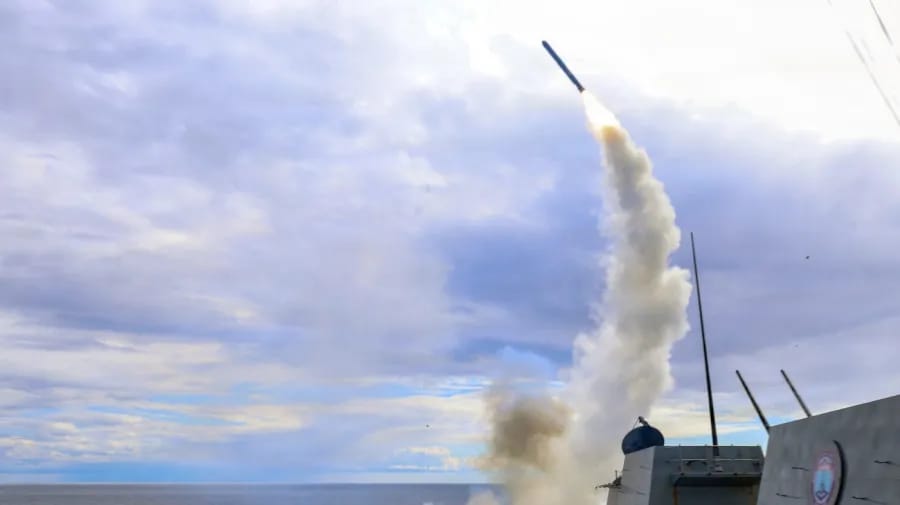
The United States has fired 1,100 long-range stealth cruise missiles since the Iran war began February 28, nearly exhausting America's arsenal of the advanced weapons needed to defend Taiwan against a potential Chinese invasion.
The massive weapons expenditure raises serious questions about America's ability to simultaneously fight Iran while deterring China in the Pacific. Military planners have long viewed these precision-guided missiles as essential for any conflict in the Taiwan Strait, where U.S. forces would need to strike Chinese naval assets from long distances.
The 1,100 missiles represent almost the entire U.S. stockpile of long-range stealth cruise missiles, weapons that cost roughly $2 million each and take months to manufacture. Defense contractors typically produce these sophisticated systems in limited quantities, making rapid replacement impossible during active combat operations.
This depletion comes as Insider Wire previously reported that America has already burned through half its Tomahawk missile inventory in the Iran conflict. The combined drain on multiple weapons systems highlights how sustained combat operations can quickly exhaust even the world's largest military arsenal.
Pentagon officials have repeatedly warned that a Taiwan conflict would require massive quantities of long-range precision weapons to penetrate Chinese air defenses and target naval forces across the vast Pacific theater. Unlike the Iran war, which relies heavily on air power projection from regional bases, a China conflict would demand sustained missile strikes across thousands of miles of ocean.
The weapons shortage creates a strategic dilemma for American commanders who must balance ongoing Iran operations with the need to maintain deterrence against Chinese aggression. Intelligence assessments continue to warn that Beijing views the current U.S. focus on Iran as an opportunity to move against Taiwan while American forces remain committed elsewhere.
Defense industry sources indicate that replacing the expended cruise missiles could take 18 to 24 months under normal production schedules. While manufacturers can increase output during wartime, the sophisticated electronics and propulsion systems in these weapons require specialized components that cannot be rapidly mass-produced.
The missile depletion also affects broader U.S. alliance commitments across multiple theaters. American security guarantees to Japan, South Korea, and Australia all depend on the ability to project firepower across the Pacific using the same weapons systems now being expended against Iranian targets.
Military analysts worry that China's intelligence services are closely monitoring U.S. weapons expenditure rates in Iran to calculate optimal timing for potential Taiwan operations. Beijing has consistently maintained that it reserves the right to use force to bring Taiwan under mainland control and has significantly increased military exercises near the island in recent months.
Congressional defense committees are expected to demand detailed briefings on weapons inventory levels and replacement timelines when lawmakers return next week.