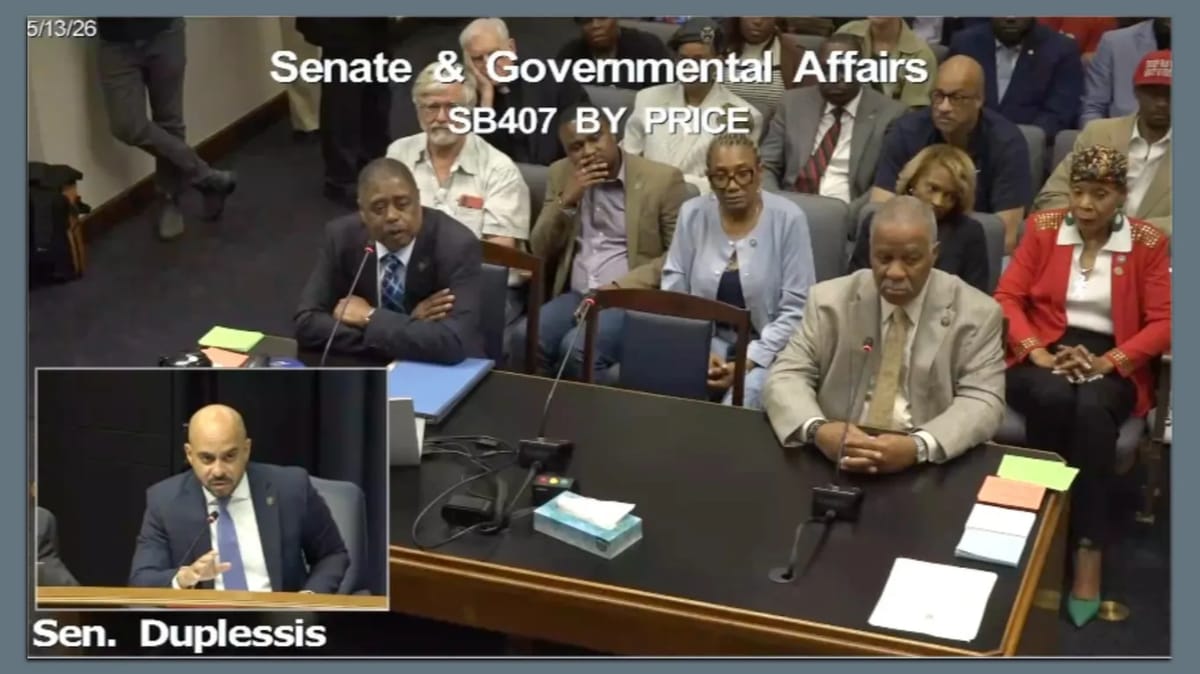
Louisiana senators voted 26-13 early Wednesday morning at 2:47 AM to advance a congressional redistricting map that eliminates one of the state's two majority-Black districts. The Senate vote followed 14 hours of heated debate that stretched from Tuesday afternoon into the early morning hours at the State Capitol in Baton Rouge.
The proposed map forces two sitting Black representatives into direct competition for political survival. U.S. Rep. Troy Carter, who represents Louisiana's 2nd Congressional District, and U.S. Rep. Cleo Fields, who won Louisiana's 6th District in 2022, would find themselves competing for the same reconfigured seat under the new boundaries drawn by the Republican-controlled legislature.
Map Consolidates Black Voters Into Single District
Louisiana's current congressional delegation includes two majority-Black districts out of six total House seats. The new map reduces that number to one, concentrating 58% of the state's Black voters into a single district while redistributing the remainder across five predominantly white constituencies.
The consolidated district would stretch from New Orleans through Baton Rouge to Shreveport, creating what critics call a "snake-like" configuration that connects Black population centers across 200 miles. State Sen. Royce Duplessis, a New Orleans Democrat, led opposition to the proposal during Tuesday's marathon session.
Under current boundaries, Carter's 2nd District includes most of New Orleans and is 63% Black, while Fields' 6th District covers parts of Baton Rouge and surrounding parishes with a 54% Black voting-age population. The new map would eliminate the 6th District entirely while expanding the reconfigured 2nd District to absorb its Black voters.
Part of National Redistricting Pattern
The Louisiana redistricting battle reflects a broader national fight following the 2020 census, which required all states to redraw congressional boundaries based on population shifts over the past decade. Republican-controlled legislatures in Alabama, Georgia, Florida, and Texas have faced similar challenges from civil rights groups over maps that potentially reduce minority representation.
Federal courts have already struck down congressional maps in Alabama and North Carolina for violating the Voting Rights Act. The Supreme Court heard arguments in October on Alabama's appeal of a lower court ruling that required the state to create a second majority-Black district.
These redistricting decisions directly impact the balance of power in the narrowly divided U.S. House of Representatives, where Republicans hold a slim majority. Louisiana currently sends four Republicans and two Democrats to Congress, with both Democratic seats held by Black representatives.
Legal Challenge Expected
The map now moves to the Louisiana House of Representatives, where Republicans hold a 68-35 majority and are expected to approve the redistricting plan within two weeks. Gov. Jeff Landry, a Republican who took office in January, has signaled support for reducing the state's Black representation from two districts to one.
Civil rights organizations have already prepared federal lawsuits challenging any final map that reduces Black representation. The NAACP Legal Defense Fund and American Civil Liberties Union argue the proposed boundaries violate Section 2 of the Voting Rights Act, which prohibits electoral changes that diminish minority voting power.
Both Carter, 60, and Fields, 62, will likely mount expensive primary campaigns to secure the consolidated district if the map survives legal challenges. Carter, a former New Orleans city councilman, won his seat in a 2021 special election. Fields previously served in Congress from 1993 to 1997 before returning to the House last year after a 25-year absence.
Key Deadlines Ahead
The Louisiana House will begin committee hearings on the redistricting proposal next Tuesday, with a floor vote expected by February 15. If approved, Landry has indicated he will sign the legislation within 48 hours.
Federal courts typically require final redistricting maps to be in place by March 1 for the 2024 election cycle. Any legal challenge would likely reach the U.S. District Court for the Middle District of Louisiana within days of final passage, setting up a potential expedited review before the May 1 candidate qualifying deadline.
The winner of this redistricting fight will represent Louisiana's Black political influence in Congress through 2030, when the next round of redistricting begins following the 2030 census.