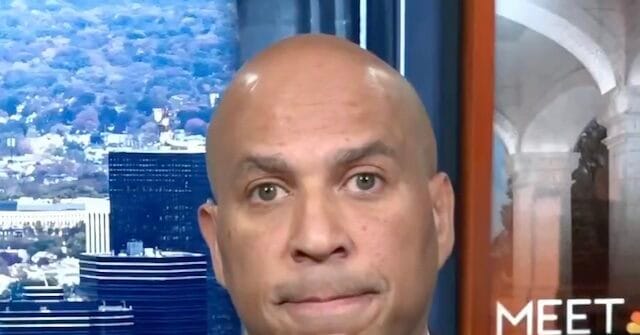
Sen. Cory Booker (D-NJ) launched a scathing attack Monday night on President Trump and Israeli Prime Minister Benjamin Netanyahu, calling both leaders "liars" and blaming them for Iran's current stockpile of highly enriched uranium.
Speaking on MSNBC's "The Weeknight" during the January 27 broadcast, Booker directly accused the two allies of endangering American national security by withdrawing from the Obama-era Iran nuclear agreement. The 84-minute interview marked Booker's most aggressive criticism of Trump's foreign policy since the president ordered the January 3 assassination of Iranian General Qasem Soleimani in Baghdad.
I want every American to know that Bibi and Donald Trump are liars, and this is why they are lying with the most insidious aims.
Nuclear Deal Fallout
The New Jersey Democrat claimed Iran possessed no highly enriched uranium before Trump and Netanyahu "ripped up" the Joint Comprehensive Plan of Action negotiated under President Obama. Booker argued the previous multilateral agreement—which included European allies, China, and Russia—successfully prevented Iran from acquiring nuclear material.
"There was no highly enriched, these hundreds of pounds of highly enriched uranium before Donald Trump and Bibi decided to take us down this disastrous road," Booker said, directly linking current Middle East tensions to the 2018 U.S. withdrawal from the nuclear pact.
Iran's uranium stockpile has grown from zero pounds of 20% enriched uranium under the JCPOA to an estimated 370 pounds as of December 2019, according to International Atomic Energy Agency reports. The original deal, signed in July 2015, required Iran to ship 98% of its uranium stockpile out of the country and allowed international inspectors access to nuclear facilities in exchange for sanctions relief worth an estimated $100 billion.
Booker used an arsonist analogy to describe Trump's approach to Iran policy, saying the president "caused this problem" and now expects Americans to trust him to resolve the crisis he created.
Broader Democratic Strategy
The senator's comments reflect a coordinated Democratic response to Trump's Iran policy following the Soleimani strike. House Democrats passed a 224-194 resolution on January 9 limiting Trump's war powers against Iran without congressional approval. Senate Minority Leader Chuck Schumer (D-NY) and Foreign Relations Committee ranking member Bob Menendez (D-NJ) have echoed similar criticisms of Trump's withdrawal from multilateral agreements.
Booker's attack also surfaces growing tensions within the Democratic Party over Israel policy. Progressive Democrats including Rep. Alexandria Ocasio-Cortez (D-NY) and Rep. Ilhan Omar (D-MN) have criticized Netanyahu's government, while establishment Democrats traditionally maintain strong support for the U.S.-Israel alliance.
Regional Security Concerns
The senator expanded his criticism beyond nuclear policy, characterizing both leaders as threats to global stability. He described Trump and Netanyahu as "two of the most disastrous leaders on the world stage" who have made Israel, the broader Middle East region, and the United States less secure.
Netanyahu faces a March 2 election in Israel while fighting corruption charges in three separate cases. Trump imposed new sanctions on Iran following the regime's January 8 missile strikes on U.S. bases in Iraq, which caused no American casualties but damaged facilities at Al Asad airbase and Erbil base.
Booker's comments come as Trump has rejected Iran's ceasefire response and taken an increasingly aggressive stance toward Tehran. The attack also surfaces tensions within the Democratic Party over Israel policy and the effectiveness of diplomatic versus military approaches to Iran.
What's Next
The timing of Booker's remarks suggests Democrats plan to challenge Trump's Middle East strategy as potentially reckless, framing the Iran nuclear issue as a crisis of the president's own making rather than an inherited problem requiring decisive action. Senate Democrats are expected to force a vote on Sen. Tim Kaine's (D-VA) war powers resolution limiting Trump's Iran authority by February 6. European allies Britain, France, and Germany triggered the JCPOA dispute mechanism on January 14, starting a 60-day process that could reimpose U.N. sanctions on Iran if diplomatic talks fail.