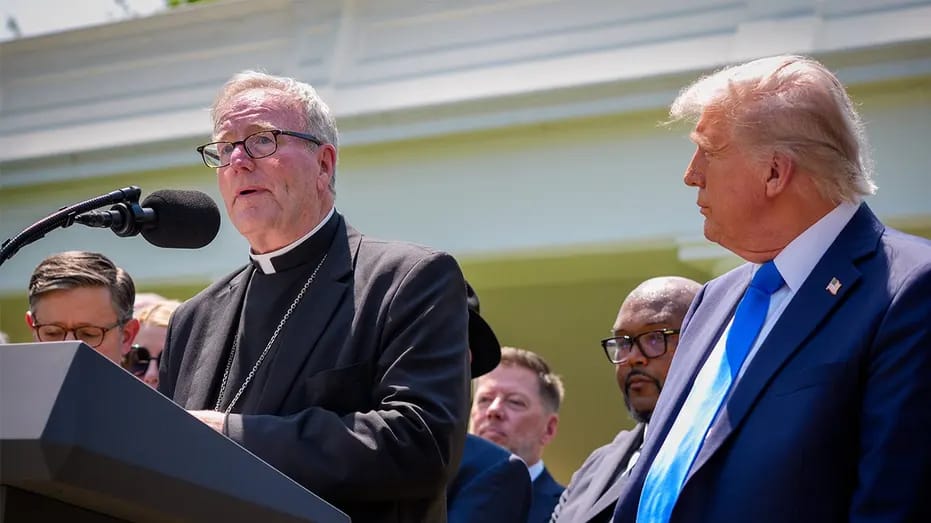
Bishop Robert Barron will warn that America's "marginalization of God" poses the "true threat to democracy" when he addresses President Donald Trump's Rededicate 250 prayer event this Sunday on the National Mall.
The Catholic bishop, widely regarded as America's most prominent religious voice, told Fox News Digital that his speech will challenge conventional narratives about democratic threats. "There's a lot of talk today about the threats to democracy, that is a true threat to democracy, the marginalization of God," Barron said in an exclusive interview.
Lincoln's 'Under God' Moment
Barron plans to open his address by invoking Abraham Lincoln's Gettysburg Address, specifically focusing on a crucial addition Lincoln made while delivering the speech. "Lincoln didn't have the phrase 'under God' when he said that this nation might have a new birth of freedom," Barron explained. "But when he delivered the speech, he said this nation 'Under God might have a new birth of freedom.'"
The bishop argues this wasn't mere political theater but reflected Lincoln's deep understanding that "God is essential to the very foundations of American democracy." This historical example will anchor Barron's broader argument that Trump administration efforts to restore traditional American values face opposition from secular forces.
The Rededicate 250 event, organized by the Trump-aligned Freedom 250 nonprofit, aims to "rededicate" America as "One Nation Under God" ahead of the nation's 250th anniversary. Trump himself is expected to attend alongside White House Cabinet members and major faith leaders.
Cultural Battle Lines
Barron's message directly challenges progressive cultural movements, arguing they stem from society's rejection of divine authority. "Take God out of the equation, what are you left with? Radical self-choice. Welcome to wokeism. Welcome to the culture of self-invention," he said.
I make myself up, values is up to me, my gender, it's up to the whole structure of my life, it's my choice. That's deadly to our democracy.
The bishop's critique extends beyond abstract philosophy to concrete policy battles. His emphasis on "radical self-choice" as democracy's enemy positions religious conservatives as democracy's true defenders against what he sees as destructive individualism.
Barron's appearance reflects the Trump administration's continued courtship of religious voters who proved decisive in recent elections. The bishop's national profile - built through his Word On Fire Ministries and media presence - gives significant weight to his endorsement of Trump's spiritual messaging.
For constitutional conservatives, Barron's argument offers intellectual ammunition in cultural debates. His position that "if you marginalize and privatize religion, democracy is in danger" directly contradicts secular arguments for strict church-state separation.
The timing proves strategic. As congressional Republicans navigate internal divisions and Trump faces various political challenges, the National Mall event offers an opportunity to reunify the conservative coalition around shared spiritual values.
Barron's message that "religion belongs to the very fabric of our democracy" provides theological backing for policy positions on issues from education to family structure. His national platform amplifies this message far beyond Sunday's audience.
The event represents a broader Trump strategy of positioning his administration as defending traditional American identity against progressive transformation. By featuring prominent religious voices like Barron, Trump aims to frame political opposition as fundamentally anti-American rather than merely partisan.
Sunday's gathering will test whether religious messaging can maintain its political potency amid ongoing national divisions. Barron's participation signals continued alliance between institutional religious leadership and Trump's political movement, with implications extending well beyond the 250th anniversary celebration.