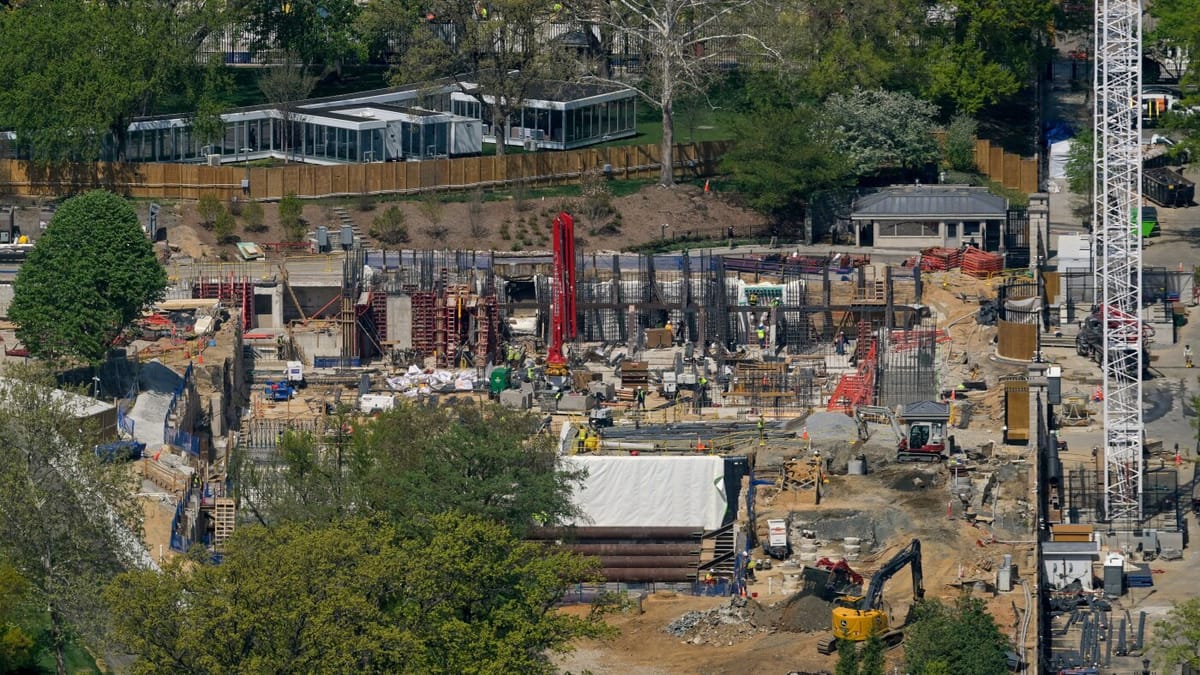
The Trump administration won a temporary victory Saturday when the D.C. Circuit Court of Appeals ruled 2-1 to allow construction on the controversial $300 million White House ballroom to continue until April 17. The decision gives Trump's legal team time to petition the Supreme Court before a lower court ruling takes effect that would halt the project for lacking congressional approval.
The appeals court stayed a March ruling by U.S. District Judge Richard Leon, a Bush appointee, who ordered construction to stop by April 14 "until Congress authorizes its completion." The administration has been battling a lawsuit from the National Trust for Historic Preservation since December over the massive neoclassical ballroom designed to seat 1,000 guests.
Construction crews demolished the East Wing in October to make room for the project. Trump revealed in March that the ballroom serves a dual purpose beyond hosting large events. "The military is building a big complex under the ballroom," Trump told reporters March 29, describing upgrades to the FDR-era bunker. The ballroom "essentially becomes a shed for what's being built under," he added, noting that "high-grade bulletproof glass" windows would protect the underground facility "from drones and from any other thing."
The president argued last month that halting construction would pose national security risks, citing the secure bunker beneath the ballroom site. The Commission of Fine Arts, controlled by a majority of Trump appointees, approved the construction in February despite the ongoing legal challenge.
Carol Quillen, president of the National Trust for Historic Preservation, expressed no alarm over the three-day extension. "The National Trust remains committed to honoring the historic significance of the White House, advocating for our collective role as stewards, and demonstrating how broad consultation, including with the American people, results in a better overall outcome," she said in a statement Saturday.
The case highlights a fundamental constitutional question about presidential power to alter federal property without explicit congressional funding approval. The administration argues the president has inherent authority to modify executive branch facilities, particularly for national security purposes. Critics contend that spending $300 million in taxpayer funds on such a massive renovation requires legislative authorization.
Trump administration attorneys declined to comment on the ruling. The Supreme Court now faces pressure to decide whether to hear the case before the April 17 deadline, setting up a potential clash over executive authority and congressional spending power that could reach beyond this single construction project.