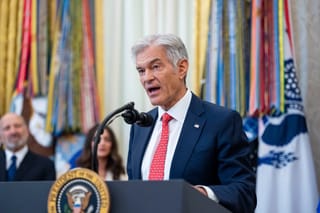
The Senate Banking Committee votes Wednesday on Kevin Warsh's nomination to replace Jerome Powell as Federal Reserve chairman, clearing the final hurdle for Trump's pick to take control of America's central bank when Powell's term expires next month.
The Fed is expected to keep interest rates unchanged at Wednesday's policy meeting, likely Powell's last as chairman after more than eight years running the central bank. If confirmed by the full Senate, Warsh would inherit an economy where inflation remains elevated and energy prices have spiked due to the ongoing conflict with Iran.
The path to confirmation cleared Friday when federal prosecutors agreed to drop their investigation of the Fed. Senator Thom Tillis of North Carolina had threatened to block the vote to protest the Justice Department probe, which critics viewed as White House pressure to force rate cuts.
"With the assurances from the Department of Justice that the case is completely and fully settled," Tillis told NBC's Meet the Press, "I am prepared to move on with the confirmation of Mr. Warsh. I think he's going to be a great Fed chair."
Warsh has argued the Fed has room to cut rates without triggering inflation, citing productivity gains from artificial intelligence. But he told senators during confirmation hearings he would operate independently from Trump's wishes.
"The president never asked me to commit to interest rate cuts at any particular meeting over the period of my tenure at the Fed," Warsh testified last week. "He didn't ask for it. He didn't demand it. He didn't require it. And nor would I have ever done so."
Even if Warsh wanted to slash rates immediately, he couldn't act alone. The Fed's 12-person committee sets interest rates by majority vote, with the chairman holding just one vote. Other committee members have expressed concerns about cutting rates while inflation persists and Iran-related energy price spikes pressure the economy.
Powell faces an unusual decision about his future. While his chairmanship ends next month, he could remain on the Fed's governing board through 2028. Most former chairs have stepped away completely, but Powell has been a fierce defender of Fed independence from White House interference.
Staying on the board would deny Trump the opportunity to fill another vacancy with his own pick. For Powell, who has repeatedly clashed with Trump over monetary policy, remaining could be seen as a final act of institutional protection.
The timing puts American taxpayers at the center of a monetary policy transition during economic uncertainty. With inflation still above the Fed's 2% target and geopolitical tensions driving up energy costs, the central bank's next moves will directly impact mortgage rates, business loans, and household budgets.
Watch for the Senate Banking Committee vote Wednesday, followed by a full Senate confirmation vote that could install Warsh as Fed chairman within weeks.