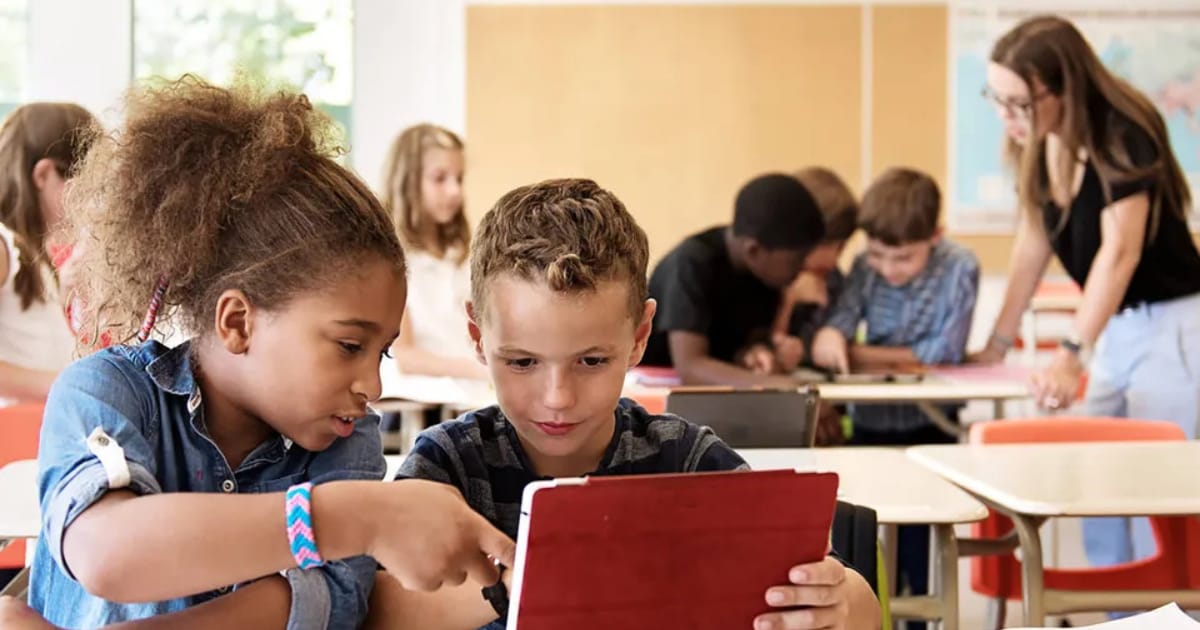
Our classrooms were designed in the 1800s to teach the masses efficiently. In 2026, we finally have the tools to teach each child individually, and one school is already trying.
The Problem
Picture a typical school day: bells ringing, kids shuffling between classes, a teacher at the front of the classroom delivering the same lesson to twenty-five different minds. For some, it's too easy; for some, it's too hard. Some are lost, some are checked out, and almost none are truly thriving at their own pace.
This is the system we’ve inherited. It was built in the 1800s for economic efficiency to teach the masses as effectively as possible. It's now 2026, and we are overdue for a change.
How Do We Fix It?
With AI, we can generate lessons tailored to each child, accounting for both their past performance and the curriculum they need to cover. Instead of one lesson aimed at the middle of the room, every student gets a lesson aimed at them.
The question is whether that actually works in practice. One school offers a look.
What This Looks Like in Practice: Mornings and Academics
A real-world example of this approach is Alpha School, a private school applying these principles at scale.
(Disclosure: I have no affiliation with Alpha and am using their model only as an example of how these concepts can work practically.)
Instead of six or more hours of passive lectures and one-size-fits-all instruction, Alpha concentrates academics into two hours. AI, not a general-purpose chatbot like ChatGPT, creates the lessons. Think of a worksheet a teacher might hand out, except it's assembled by software: read this, watch this video, answer these questions on the material. Each one is built around that specific student's difficulty level and exactly where they left off.
Alpha says this approach lets many students learn 2.6 times faster than peers in traditional classrooms, with some completing full grade levels in as little as 20 to 30 hours.
Instead of delivering lectures or grading assignments, Alpha's teachers serve as "guides" who motivate and coach each student, working to unlock their drive and potential.
And because academics wrap up in the morning, the afternoon is free for something else entirely
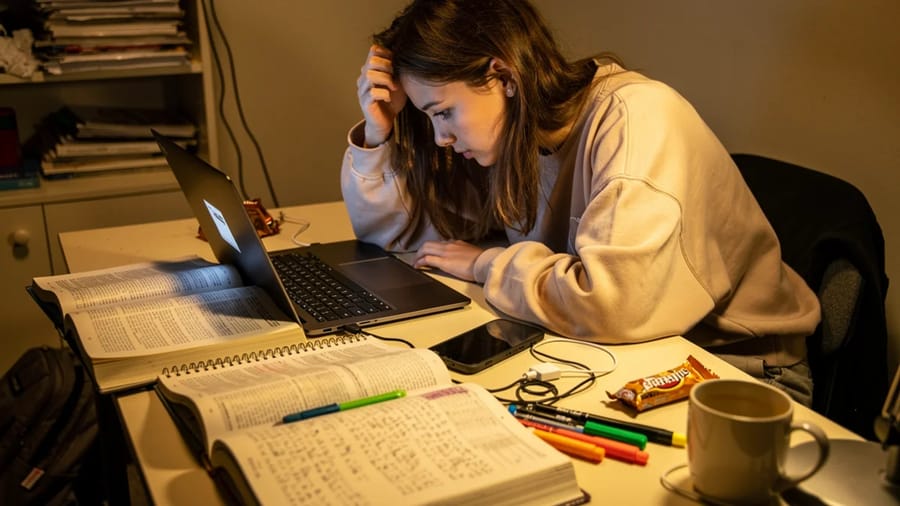
Afternoons: Life Skills Workshops
Here is how Alpha describes the second half of the day:
"The workshops are taught by entrepreneurs, athletes, copywriters, lawyers, finance professionals, and traditional educators. Each lasts 8 weeks on average. At the end of the 8 weeks, students must prove they can actually do what they were taught."
The list of topics includes leadership and teamwork, storytelling and public speaking, financial literacy, relationship-building and socialization, and grit and hard work.
The clearest illustration is what happens to the youngest students:
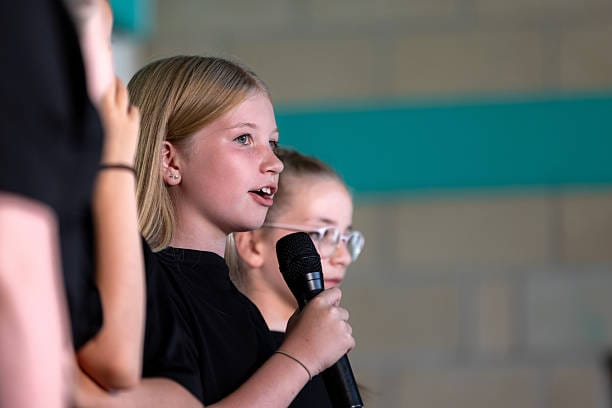
"Second- to third-graders become 'Alpha Ambassadors.' They give full tours of their school, mic'd up and live, using Aristotle's rhetorical framework of ethos, logos, and pathos."
Each leg of that framework becomes a requirement:
- Ethos — credibility. Students must demonstrate expertise and honesty to show why they're a trustworthy source.
- Pathos — empathy. Students must use storytelling to connect on a personal level.
- Logos — logic. Students must share facts, data, and statistics.
In short: an eight-year-old has to explain the school's basic facts, the deeper philosophy behind them, and why they specifically are a trustworthy source of that information — all while connecting emotionally with an audience. The final exam isn't a test. It's becoming a tour guide.
More on the afternoon workshops: How Alpha Grades Life Skills
Frequently Asked Questions
What about socialization?
"While students spend 2 hours on apps in the morning, the rest of their day is spent engaging with their peers and getting direction from the guides via a variety of lively activities. In fact, because they don't have to spend 6 hours looking in the same direction at a chalkboard, Alpha students get more socialization than the average school student."
What does it cost per student?
Alpha's public FAQ says only that tuition "remains on par with the nation's best private schools." Reported figures vary by campus, with some reaching roughly $65,000 a year.
The more important number is the trajectory. The cost of the AI instruction itself — the part that replaces the lecture, falls every year. The long-term goal for a model like this is on the order of $1,000 annually per student, which is the threshold at which it stops being a luxury product and starts being a global one.
Is this proven?
Alpha School has been operating for over a decade and continues to expand. Students regularly sit nationally recognized assessments such as MAP Growth, which measure progress against national benchmarks.
Alpha has published its mid-year report card for the 2025–2026 school year. Two highlights:
"Across virtually every grade level (K-12) and subject, Alpha District's average student is scoring better than 99% of individual students nationwide."
"Alpha's results indicate performance comparable to the top 0.1% of schools globally."
Worth noting: these figures are self-published by the school rather than independently audited, and a selective private school with engaged, high-income families would be expected to outperform national averages regardless of teaching method. That doesn't make the results meaningless — it means the interesting question is how much of the gap the model itself explains.
For an outside look, Astral Codex Ten published a detailed independent review of Alpha written by a parent whose children attend the school. It ran as a finalist in the site's 2025 review contest.
How are students motivated?
Both individually and collectively:
"Guides are responsible for understanding what motivates each student and designing collective rewards when students meet their goals. The guides also ensure that students understand the logic behind the motivation model, ultimately making children self-driven. Students can earn time outside, or in the Alpha 'ThinkTank' room, or earn 'Alphas' — their school currency that they can use to purchase prizes or larger rewards such as a laser tag party."
Is this scalable?
AI-driven education models scale because they substantially lower operational costs, which is what makes high-quality personalized learning affordable rather than exclusive.
There's a second, less obvious reason. By handing core academic instruction to software, these models narrow the teacher's role to motivation and student support. That makes qualified staff far easier to recruit and hire — a real constraint in a world with a chronic teacher shortage.
More questions answered: Alpha School FAQ

The Bigger Picture
As I said at the start, I believe we can deliver a personalized "top 1%" education to a billion kids.
Alpha is one school with one implementation, and a single expensive private school is not proof that the model works everywhere. But it is a working demonstration that the two-hour academic day is possible at all, and that's the part worth paying attention to. The gap between "possible" and "affordable" is an engineering problem, and engineering problems tend to get solved.
I hope this becomes a long-term domino effect that improves, or solves, a multitude of other problems in the world. An educated billion people is not a small lever.