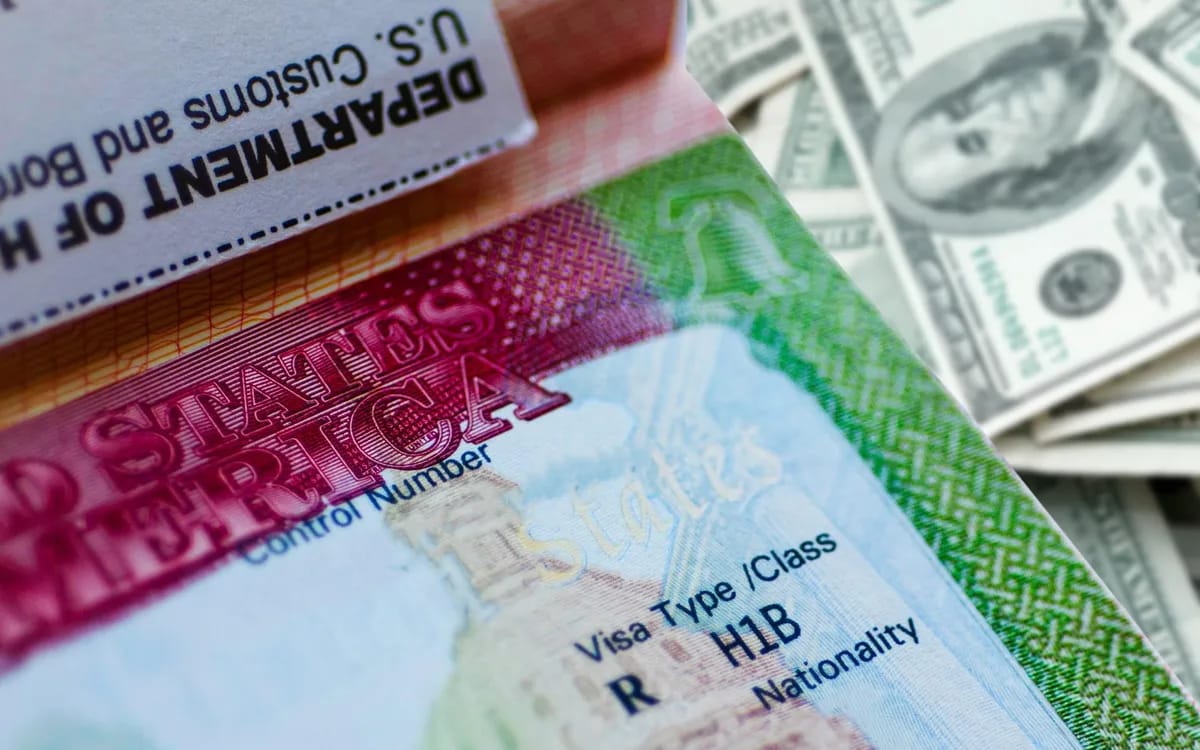
President Trump has signed two actions on H-1B visas on Friday, extending the 100,000 payment requirement on H-1B petitions for another year, and ordering federal agencies to begin investigating employers who sponsor visas for fraud.
The 100,000 payment requirement was set to expire tomorrow.
The proclamation: 100,000, extended to 2027
The proclamation "Restriction on Entry of Certain Nonimmigrant Workers" extends the entry restrictions first imposed by Proclamation 10973 in September 2025. H-1B petitions accompanied by, or supplemented by, a payment of 100,000 will be processed.
The payment took effect September 21, 2025 and was set to expire September 21, 2026. It is now extended to 12:00 a.m. EDT September 21, 2027.
The proclamation invokes sections 212(f) and 215(a) of the INA, the authority the president has to suspend or restrict entry of foreign nationals. The DHS will have the authority to exempt individual hires if the Secretary of DHS determines that it's in the nation's interest and does not threaten US security or welfare. The State department will have to confirm payment before issuing a visa. State and DHS are tasked with coordinating to deny entry if the employer hasn't paid.
The executive order: agencies told to start looking
The second action is an executive order on H-1B program integrity and interagency coordination.
State, Labor and DHS are now tasked with coordinating and consulting with Commerce, Education and the Small Business Administration on H-1B petitions, labor condition applications and visas. Commerce, Education and SBA will provide wage, employment, academic and industrial data.
State, Labor and DHS are directed to consider whether a sponsoring employer has laid off US workers in the past year or plans to, directly or indirectly, when considering H-1B petitions.
The toughest deadline in the order is on Labor. The DOL's Wage and Hour Division must begin analyzing data from labor condition applications that were submitted in the past 30 days (by October 18) to determine if it takes action against sponsoring employers under INA 212(n)(2)(G), the law that lets the Secretary open investigations without having to wait for a complaint.
The order also delegates the president's authority under INA 215(a) to the Secretaries of State, Commerce, Labor and Homeland Security to implement.
What the order says about the program
The order details the administration's position that the H-1B program has been "widely abused by certain employers, third-party placement groups, and outsourcing firms to undercut and displace the supply of skilled United States labor."
Highlights of the order include:
- H-1B workers earn 9,000 less, on average, than comparable US-born workers, the order estimates, with the wage gap potentially reaching 20,000 in H-1B-reliant industries.
- Tech companies laid off as many as 800,000 to 1.3 million American workers between 2022 and 2026 while collectively seeking hundreds of thousands of H-1B visas.
- The top six users of the outsourcing model had over 25,000 H-1B cap registrations for Fiscal Year 2026.
- Government investigations have found employers misrepresenting job duties and working conditions to falsely classify jobs as specialty occupations or reduce wage requirements, filing "questionable foreign degrees from diploma mills."