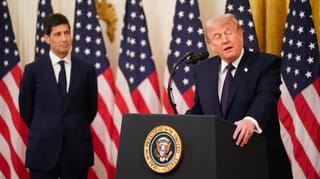
President Trump unleashed a scathing attack on Justices Neil Gorsuch and Amy Coney Barrett, both his own appointees, after a Supreme Court decision on tariffs that he says will cost America $159 billion in refunds to foreign countries and companies. The ruling, delivered in late January 2025, struck down key provisions of Trump's Section 301 tariffs on Chinese goods and Section 232 steel and aluminum duties.
Sign in or create a free account.
Gain access to limited free articles, news alerts, and morning briefings.
By continuing, you agree to the Terms of Service and Privacy Policy.
Enjoy unlimited access to Insider Wire.
See subscription optionsTrump expressed frustration that the two conservative justices voted against his tariff policies in what he called a "devastating move" that hurt the country. The president argued the justices could have solved the problem with a simple sentence declaring that "any money paid by others to the United States does not have to be paid back." The 6-3 decision found that Trump's original tariff implementation violated the Administrative Procedure Act and exceeded executive authority without proper Congressional authorization.
Republican Justices Show 'Little Respect'
The president went further, suggesting that Republican-appointed justices routinely abandon conservative principles to appear "independent" while Democratic justices remain loyal to their appointing presidents. Trump claimed that "with certain Republican Nominated Justices that we have on the Supreme Court, the Democrats don't really need to 'PACK THE COURT' any longer." Chief Justice John Roberts and Justice Brett Kavanaugh joined the majority opinion alongside the Court's three liberal justices.
In a remarkable reversal, Trump declared: "In fact, I should be the one wanting to PACK THE COURT!" The statement represents a dramatic shift from traditional Republican opposition to court packing schemes. House Republicans have consistently blocked Democratic proposals to expand the Court from nine to thirteen justices since 2021.
Trump revealed he recently became the first president in history to attend a Supreme Court session on January 28, 2025, when oral arguments were heard in the tariff case. He complained the court failed to acknowledge this historic moment "out of respect for the position of President." Chief Justice Roberts made no mention of Trump's presence during the proceedings, breaking with protocol typically reserved for State of the Union addresses.
Pattern of Trade Policy Defeats
The tariff ruling continues a string of judicial setbacks for Trump's trade agenda dating back to his first term. Federal courts have overturned or modified $847 billion in tariff collections since 2018, with the Court of International Trade alone processing over 2,400 refund claims from importers. The latest decision affects duties on $370 billion in annual Chinese imports and $48 billion in steel and aluminum from multiple countries.
Business groups led by the U.S. Chamber of Commerce and National Association of Manufacturers have spent $127 million on legal challenges to Trump's trade policies since 2017. The Supreme Court case consolidated 47 separate lawsuits filed across eight federal district courts, with plaintiffs including major retailers like Walmart, Home Depot, and Target.
Birthright Citizenship Battle Looms
The president warned that the same justices will likely rule against his birthright citizenship executive order, calling the current policy an "unsustainable, unsafe, and incredibly costly DISASTER." Trump argued this would make America "the only country in the world" that practices birthright citizenship. His executive order, signed January 20, 2025, attempts to end automatic citizenship for children born to undocumented immigrants or temporary visa holders.
As Insider Wire previously reported, the administration has been processing billions in tariff refunds following court challenges to Trump's trade policies. The Treasury Department estimates $12.3 billion in refunds will be processed monthly through December 2025.
What Comes Next
Despite the setback, Trump indicated he has "another way of doing Tariffs," though he acknowledged it would be "far slower, and more laborious" than the method the Court deemed unconstitutional. White House trade advisors are drafting legislation requiring Congressional approval for new tariffs, potentially delaying implementation until late 2025. The original tariff decision was reportedly close, with three justices writing "powerful, and highly accurate" dissents according to Trump.
The president's frustration extends beyond policy disagreements to what he sees as a pattern of disloyalty from Republican appointees who prioritize appearing above politics over advancing conservative goals. Trump emphasized he doesn't want personal loyalty, "but I do want and expect it for our Country." The birthright citizenship case faces oral arguments on March 15, 2025, with a decision expected by June.