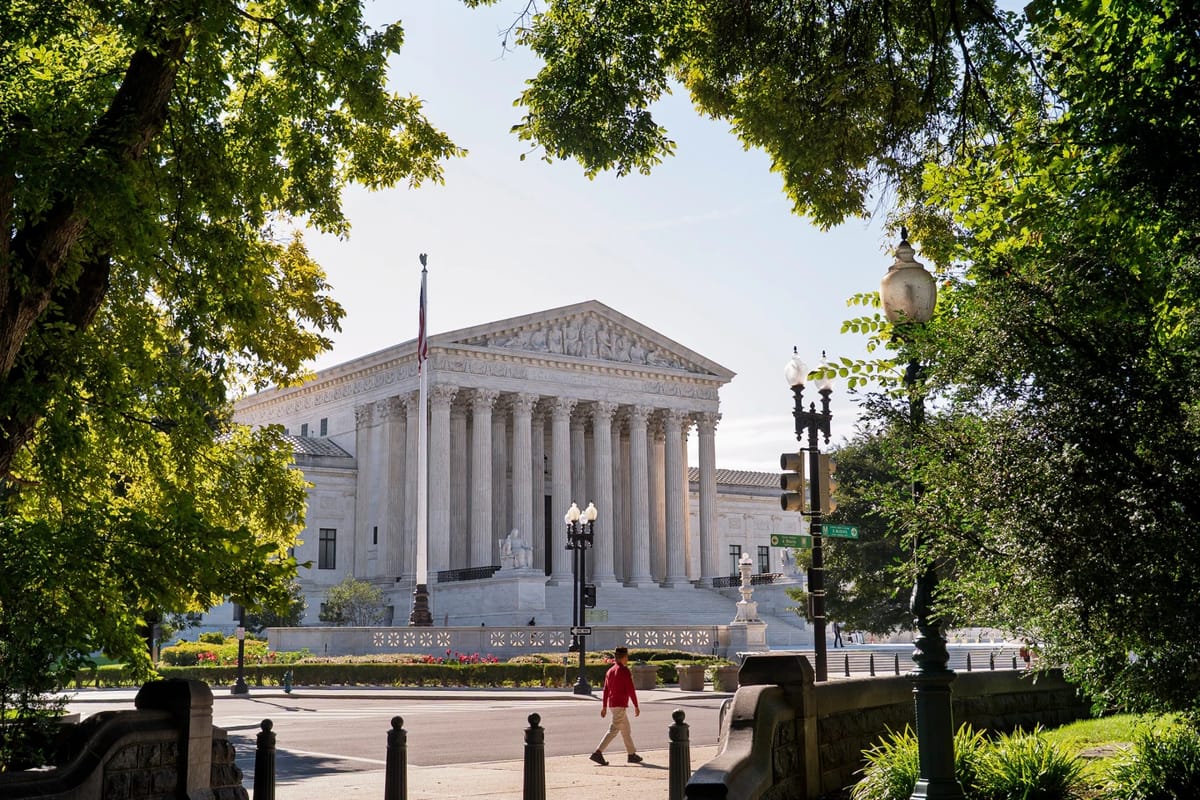
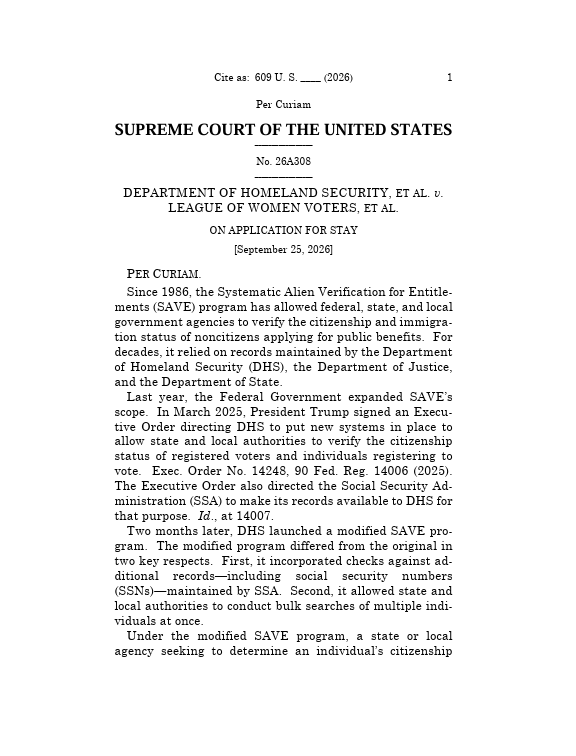
The Supreme Court issued an emergency stay Friday, allowing the Trump administration to proceed with its efforts to expand a voter citizenship verification system while a lawsuit against the program continues.
The unsigned order in the Department of Homeland Security v. League of Women Voters case granted a stay of a district court decision that halted the program.
Justice Ketanji Brown Jackson wrote a dissenting opinion, which was joined by Justice Sonia Sotomayor and Justice Elena Kagan.
The Systematic Alien Verification for Entitlements program was created in 1986, to enable agencies to verify the immigration status of individuals receiving public benefits. States began using the program for voter verification in 2005 and 27 states currently do. In March 2025, President Trump signed an executive order that caused the Department of Homeland Affairs to rebuild the program to include information from the Social Security Administration such as Social Security numbers, and to enable state and local officials to conduct bulk searches rather than one name at a time.
The League of Women Voters and the Electronic Privacy Information Center filed a lawsuit against the program, claiming it violated a confidentiality provision in the Social Security Act, the Privacy Act and the Administrative Procedure Act. In June, a federal district court agreed, vacating the modifications on all three charges. A divided D.C. Circuit panel refused to issue a stay, with Judge Gregory Katsas dissenting.
The Supreme Court reasoned its decision based on an immigration statute enacted in 1996, 8 U.S.C. §1373, which forbids any government entity, official, person or agency from inhibiting the exchange of citizenship information with the Department of Homeland Security, "notwithstanding any other provision" of law. Combined with §1373(c), which requires the Department of Homeland Security to respond to state and local citizenship inquiries, the Court found Congress "necessarily authorized DHS to request and receive that information," and that the law preempts disclosure prohibitions elsewhere in the code.
Regarding the equities of the case, the Court wrote that the district court's order "prevents the Federal Government from using the program it believes is best suited to the task."
Importantly, the Court rejected the government's claim that the plaintiffs lacked standing, citing the case of a Louisiana resident whose name in the SSA records did not reflect her naturalization and who would have had to produce additional proof of citizenship.
In practice, the effect of the decision is less sweeping than it seems. State law prohibits states from systematically removing the names of voters from the voter rolls within 90 days of a federal election, an embargo that has long since expired before the November elections. The majority recognized this, saying the moratorium "limits the potential impact" of the stay, and that what the order really restores is the ability to conduct individualized searches. Jackson more succinctly wrote that the decision will likely have little short-term impact.
She dissented on the basis that the majority erroneously read the statute. Section 1373(a) and (b) prohibit officials from taking action that impedes lawful information exchanges, she wrote, but do not positively grant power or preempt express statutory confidentiality provisions. She observed that the government had not previously used this section in three decades, and cited a 1999 Office of Legal Counsel opinion that concluded it did not clearly authorize disclosures otherwise prohibited by federal statute.
Jackson also took issue with the majority for only considering the government's position, referencing findings by the district court that damage had already been done in Texas, where one plaintiff had her registration revoked without her knowledge, and two others had to produce proof of citizenship to remain registered.
The stay is in effect until the D.C. Circuit appeal and any subsequent certiorari petition. The Court also mentioned the Republican National Committee v. Mi Familia Vota case, which asks whether the 90-day moratorium prevents states from removing the registrations of noncitizens, as a question for another day.