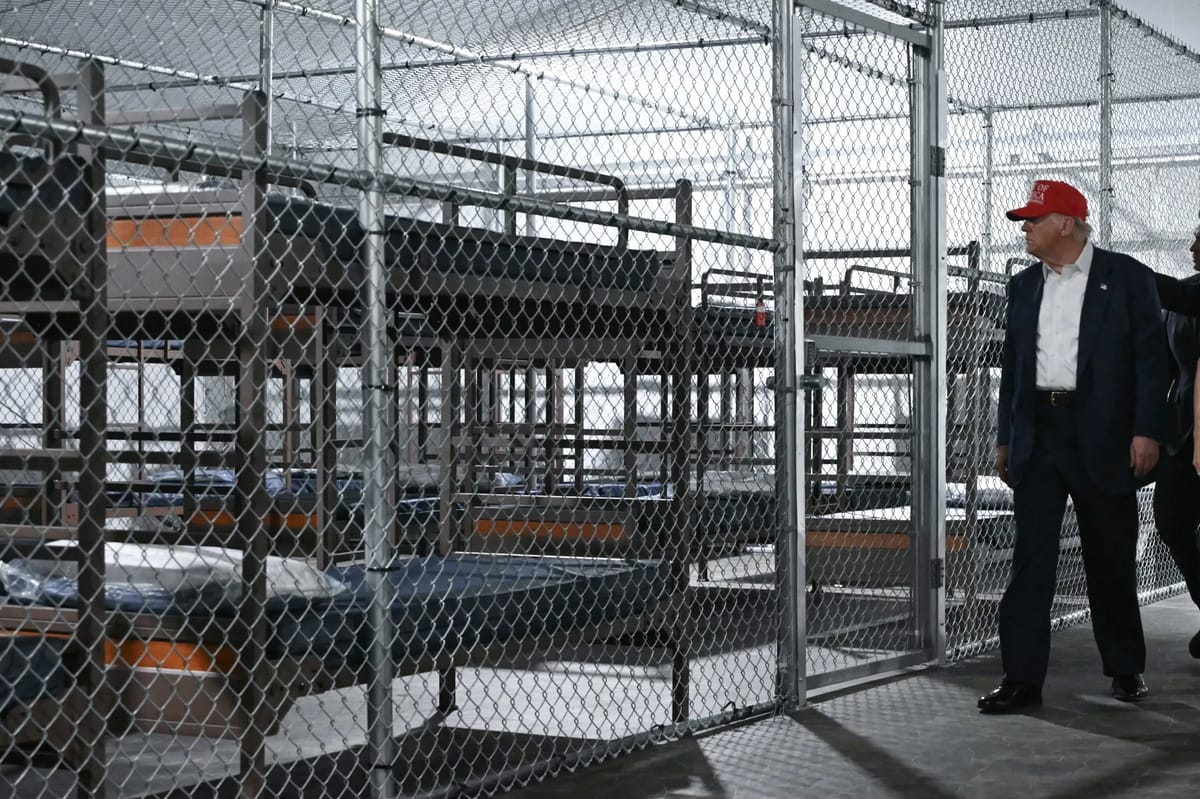
The Department of Homeland Security has bought two immigration detention centers in Adelanto from the GEO Group for 950 million. The two purchases add up to nearly 3.2 billion that the federal government has spent on immigration detention facilities, much of it in California.
The announcement on Monday stated that the 704-bed Desert View Annex and the two-building, 1,940-bed Adelanto ICE Processing Center were purchased. GEO, a Florida-based government contractor, will transfer the buildings to the federal government, but it expects to continue operating both facilities under its contract with ICE.
The purchases come after a 1.5 billion investment in July, when CoreCivic sold the 1,994-bed Otay Mesa Detention Center in San Diego County and the 2,560-bed California City Detention Facility in Kern County. Those deals closed July 2 and netted CoreCivic about 1.1 billion.
DHS has made clear that the purchases are in response to California's efforts to limit immigration detention. The department has said that federal ownership of detention centers is what protects the ICE detention network from state regulation of private facilities. ICE spokesman Jason Sweeney has said that California's detention centers are critical to ICE's detention network on the West Coast.
The timing is no coincidence. Just on Sept. 29, Gov. Gavin Newsom signed AB 1633, which levies an annual tax equal to 25 of gross receipts on private detention facility operators and includes a bill to end a property tax exemption that some facilities had been claiming. A facility that is federally owned, rather than privately run, would not be affected by the tax and it as written it would not apply.
CalMatters revealed that DHS paid well above assessed value for the buildings in the summer. The Otay Mesa Detention Center went for 739.2 million, or about 4.5 times its assessed value. California City was assessed at 171.5 million and sold for 732.6 million, or about 4.3 times its assessed value.
San Diego County Supervisor Paloma Aguirre linked CoreCivic's decision to sell to the company's 500,000 donation to President Trump's inaugural committee.
The 2025 budget allocated nearly 170 billion for DHS to spend on immigration enforcement and detention, 45 billion of which is authorized for detention capacity expansion through fiscal 2029.
An ICE document estimated that the total cost of the detention center expansion would be 38.3 billion. Originally, ICE planned to buy general-use warehouses to convert to detention centers, about 20 nationally, including 1 billion for 11 sites early in 2026. Communities opposed the purchases, including Republican-leaning areas, and ICE suspended warehouse purchases on March 31. Rep. Rashida Tlaib proposed a bill in April to ban warehouse conversions altogether.
Buying fully staffed prisons from established contractors solves both issues. The facilities are already populated with people being held and have all the necessary licensing in place. The company that built the prison will also manage the facility.
California has now lost most of its ability to influence four of its largest immigration detention facilities. The state's levers now relate to state property, state resources, public records, and the behavior of law enforcement within the state, rather than the ownership or taxation of federal buildings. Newsom's own office admitted in its Sept. 29 announcement that it can't control federal immigration policy.